
In the vast and ever-shifting landscape of modern body art, trends emerge, burn brightly, and often fade into obscurity. Yet, through it all, one style remains a steadfast and unshakable pillar of the craft. It is the bedrock of Western tattooing, a visual language so powerful and so perfectly designed for the medium of skin that its rules, motifs, and unapologetic attitude continue to influence every artist working today. This is the Traditional Tattoo Style tattoo style. Its unmistakable bold black outlines, explosive bursts of strong primary colors, and iconic symbolism are instantly recognisable—a timeless mark of rebellion, heritage, and pure, unadulterated tattoo artistry that feels as relevant on the streets of London in 2025 as it did in the port cities of a century ago.
This is more than just an “old school” aesthetic; it is a discipline, a craft governed by a strict set of unbreakable rules that were forged out of necessity and perfected through generations of practice.1 These rules were created to do one thing above all else: to create a tattoo that would look bold, clear, and beautiful on the day it was done, and remain bold, clear, and beautiful fifty years later. Understanding this history and these principles is the key to appreciating the enduring power of this incredible art form.
At midnightt, our private, appointment-only studio is a space where the heritage of tattooing is deeply respected. Our artists are not just practitioners; they are students of the craft, masters of its history, and experts in executing its most iconic styles with modern, clinical precision. This is your definitive guide to the Traditional Tattoo Style tattoo style. We will delve into its fascinating history, deconstruct its visual language, decode its most powerful symbols, and explain how we honour this legacy while creating unique, personal pieces for the modern London collector.
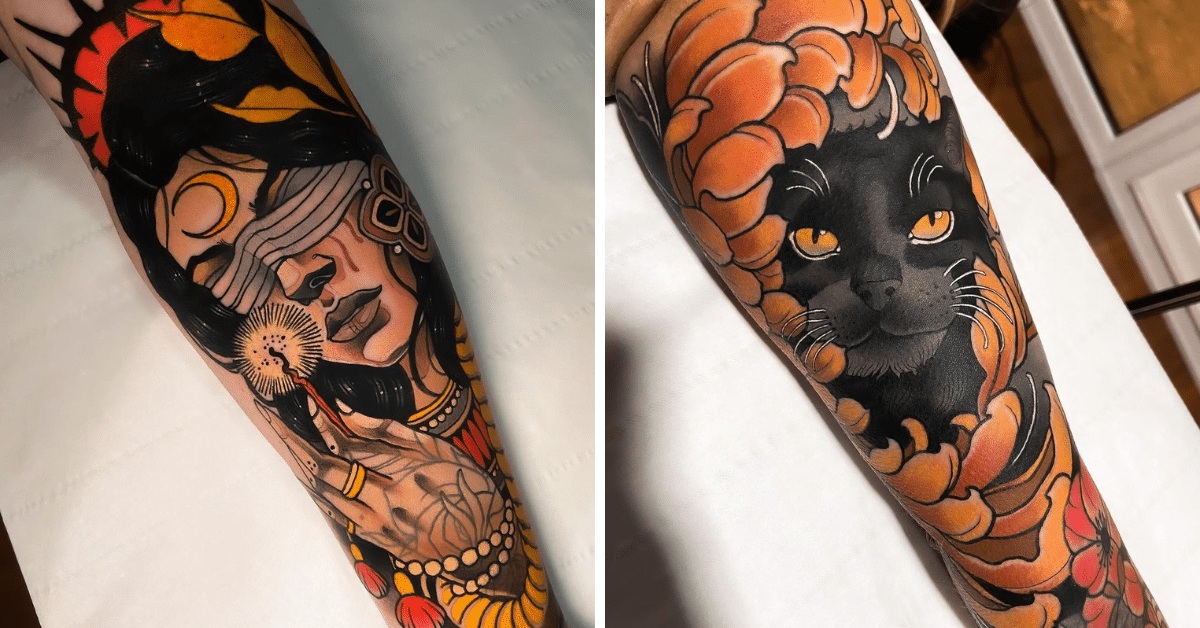
Traditional Tattoo Style
A Legacy Forged in Boldness: The Origins of a Timeless Style
To understand the look of the Traditional Tattoo Style tattoo style, you must first understand its origins. It is a style born not in art schools or sophisticated galleries, but in the rough, transient, and superstitious world of sailors, soldiers, and travelling showmen.2 It is an art form forged from adventure, necessity, and the human desire to mark one’s own story on the skin.
Born in the USA, 1930s: A Style for a Changing World
While the roots of Western tattooing stretch back further, the distinct visual language we now know as American Traditional was codified and popularised in the USA, from the 1930s onwards. This was a pivotal time in American history. The cultural context of the post-Depression era, the social changes of a rapidly industrialising nation, and the significant military build-up leading into World War II created the perfect environment for this art form to flourish. Tattoos became a mark of identity for a growing working class and for the thousands of young men joining the armed forces. They were a way to carry a piece of home, a symbol of luck, or a badge of honour into an uncertain world. The style needed to be quick to apply, visually impactful from a distance, and durable enough to last a lifetime of hard work and sun exposure. The artists of the era rose to this challenge, creating the foundational rules that still define the style today.
The Godfathers of the Craft: The Innovators Who Defined the Look
As tattooing moved from the ship to the shore, setting up shop in the rough-and-tumble entertainment districts and military towns of America, a handful of pioneering artists began to codify and perfect this nascent art form. They are the godfathers of modern tattooing.
- Norman “Sailor Jerry” Collins (1911-1973):4 Arguably the single most influential figure in the history of the Traditional Tattoo Style tattoo style, Sailor Jerry was a true innovator.5 Based in Honolulu, Hawaii, his shop became a legendary destination for soldiers and sailors passing through. He was not content with the limited technology of the time. He was one of the first artists to create his own safe, vibrant pigment colours, expanding the palette beyond the simple black and red of his predecessors. He pioneered the use of single-use needles and implemented hospital-grade sterilisation techniques, a revolutionary concept at the time. Artistically, he was a master. He was deeply influenced by the bold compositions and powerful lines of Japanese tattooing (Irezumi), and he integrated this artistic sophistication into his own iconic, all-American designs. His work was cleaner, bolder, and more artistic than anyone who had come before him.
- Don Ed Hardy (1945-Present): If Sailor Jerry was the master innovator of the craft, Ed Hardy was the artist who bridged the gap between the tattoo “parlour” and the fine art world. A trained artist with a Bachelor of Fine Arts degree, Hardy saw the immense artistic potential of tattooing. He studied under Sailor Jerry and, like him, was deeply influenced by Japanese art. Hardy’s work brought a new level of artistic complexity and conceptual depth to the Traditional Tattoo Style tattoo style. Through his publications, art shows, and later his famous clothing brand, he was instrumental in elevating the public perception of tattooing from a back-alley trade to a legitimate and powerful global art form.
- Bert Grimm (1899-1985) & Others: Figures like Bert Grimm, who ran a world-famous shop in Long Beach, California, were masters of the craft and living encyclopedias of traditional flash. They, along with countless other artists in shops across America, were the custodians of the style, tattooing thousands of soldiers and sailors and solidifying the visual language that we now recognise as classic American Traditional.
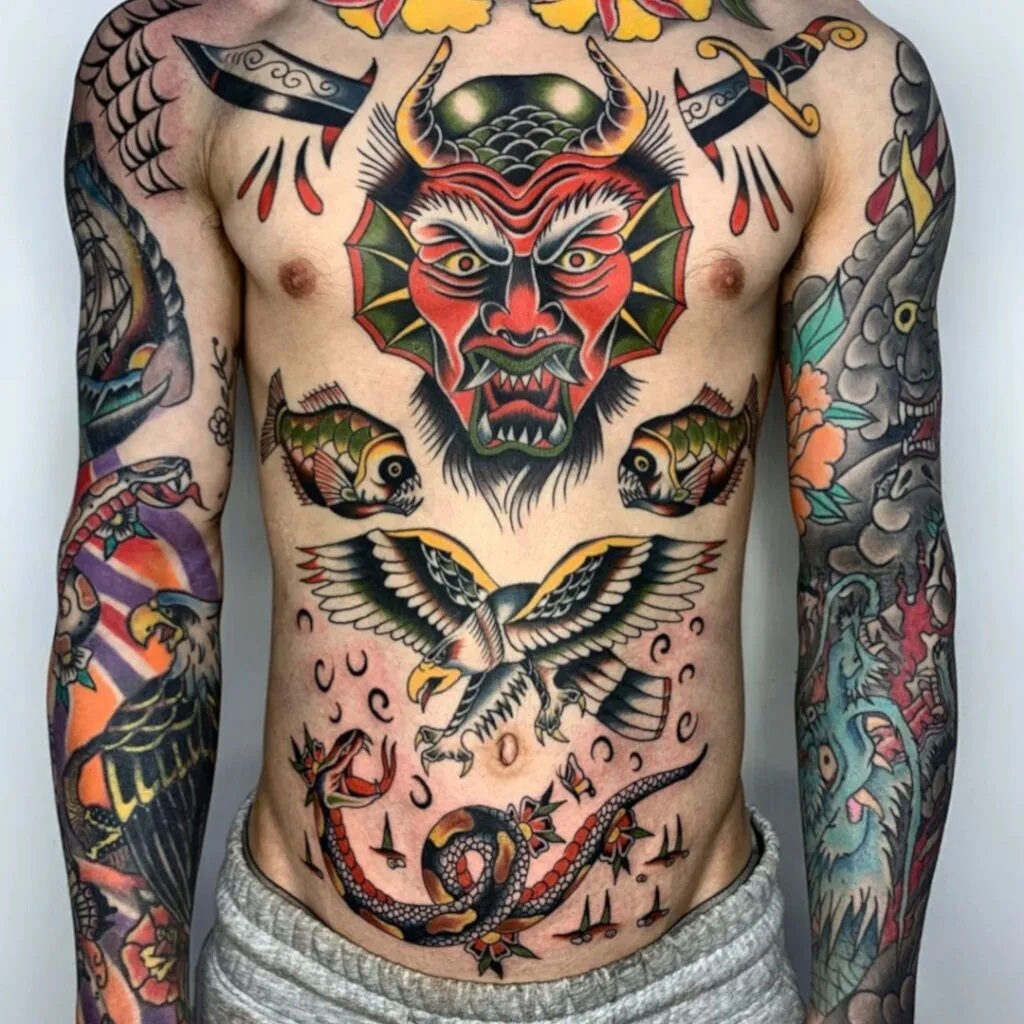
Traditional Tattoo Style
The Unbreakable Rules: Deconstructing the American Traditional Aesthetic
The Traditional Tattoo Style tattoo style is a discipline governed by a strict set of visual rules.6 These rules were not arbitrary aesthetic choices; they were practical solutions to the limitations of early tattoo machines and pigments, and they were designed with one primary goal in mind: longevity.7 The pioneers of this style knew that the skin was not a static canvas. It ages, it stretches, it is exposed to the sun. They created a formula to ensure their art would stand the test of time.
“Bold Will Hold”: The Philosophy of the Heavy Black Outline
This is the single most important rule. Every design is built on a foundation of bold black outlines. These are not delicate or subtle; they are thick, solid, and powerful, applied with a confident and steady hand.
- The Rationale: The pioneers of the craft understood that over decades, as skin ages and ink particles naturally spread and soften, fine lines can blur and become unreadable. A bold black outline acts as a strong container, a retaining wall that holds the entire design together. It provides a powerful graphic structure that ensures the core image remains clear, sharp, and instantly readable from a distance, even fifty years after it was first applied. This commitment to longevity is the very soul of the style. The phrase “Bold Will Hold” is a sacred mantra for every traditional artist, a promise of a tattoo that will last a lifetime.
A Powerful Palette: The Use of Strong Primary Colors
The classic American Traditional palette is famously limited and powerful. It consists primarily of strong primary colors: red, yellow, green, and blue.
- The Rationale: This was initially a technological limitation; in the early 20th century, these were the only pigments that were reliably safe, durable, and commercially available. However, this constraint became a powerful stylistic strength. The use of a few bold, primary colours creates a look that is incredibly graphic, vibrant, and visually impactful. It forces the artist to focus on strong composition and clear readability rather than subtle blending, resulting in a tattoo that “pops” off the skin with an unmistakable energy and a classic, comic-book-like appeal.
The Art of Limited Shading and Solid Saturation
The Traditional Tattoo Style tattoo style is not known for its subtlety. Its approach to colour and shadow is as bold as its outlines.
- “Colour Packing”: Areas of colour are not delicately blended or rendered with soft gradients. Instead, they are “packed” into the skin. This means the artist works the area with their needles until it is completely and solidly saturated with pigment. This technique ensures the colour is as vibrant, rich, and long-lasting as possible, preventing a washed-out or faded look as the tattoo ages.
- Limited Shading: The style features limited shading, which is typically done with solid black ink. It is used to create contrast, depth, and dimension, but it is applied in a bold, deliberate manner. You will often see stark transitions from colour to black rather than the soft, smooth gradients seen in realism. This heavy use of black further contributes to the tattoo’s longevity and powerful visual weight, anchoring the design in the skin.
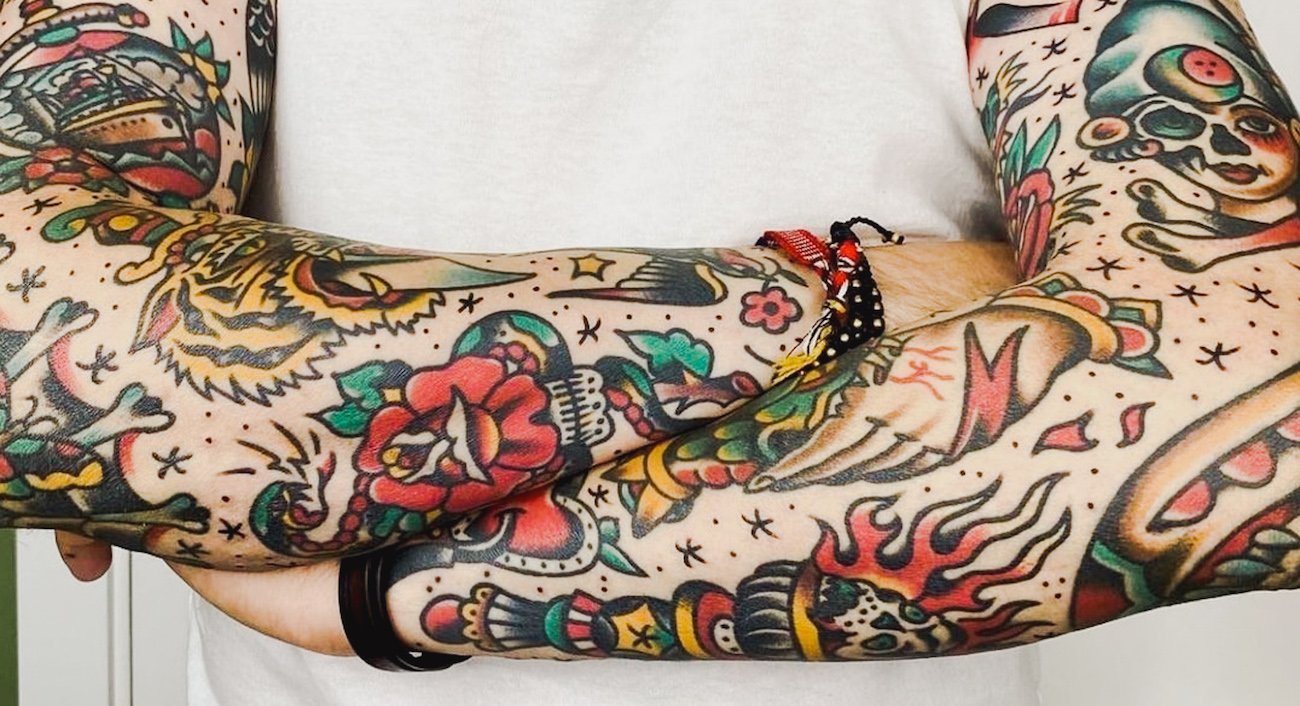
Traditional Tattoo Style
A Lexicon of Legends: Common Motifs and Their Meanings
The Traditional Tattoo Style tattoo style is a language of symbols. Each of the classic designs carried a specific and widely understood meaning, particularly within the maritime and military cultures where it was born. Understanding this lexicon of common motifs adds a layer of depth to appreciating these timeless designs.
| Motif (Symbol) | Traditional Meaning & Symbolism |
| Roses | A profound and universal symbol of love, beauty, passion, and femininity. Often tattooed in tribute to a mother, wife, or girlfriend. A rose with a dagger can symbolise the duality of love and pain (betrayal/heartbreak). |
| Eagles | The ultimate symbol of America. Represents honour, patriotism, strength, courage, and freedom. Often depicted locked in battle with a snake or clutching an American flag. |
| Daggers | A symbol of bravery, justice, and a “death before dishonour” attitude. When piercing a heart, it is a powerful symbol of betrayal and heartbreak. When piercing a skull, it represents a conquest over death or an acceptance of mortality. |
| Anchors | The ultimate symbol of stability, security, and being grounded. For a sailor, it signified having successfully crossed the Atlantic Ocean and was a powerful talisman for a safe return home. |
| Skulls | A classic memento mori, a powerful reminder of one’s own mortality and the acceptance of fate. It is also a timeless symbol of rebellion, a defiant spirit, and a life lived outside the lines. |
| Pin-up Girls | A reminder of the feminine ideal or a specific loved one left at home. A symbol of beauty, desire, and the life a sailor or soldier hoped to return to after their long tour of duty. |
These are just a few of the core symbols. Other powerful and frequently seen motifs include the swallow (representing a sailor’s experience and the promise of a safe return), the full-rigged ship (signifying a perilous journey completed), the panther (ferocity and power), and the snake (a dual symbol of danger and transformation).
The Vibe & Placement: Capturing the Authentic Look
The combination of these elements—bold lines, strong colours, and iconic motifs—creates a very specific and powerful overall vibe that has remained potent for nearly a century.
The Feeling of American Traditional: Timeless, Masculine, Nostalgic, Bold
The Traditional Tattoo Style tattoo style is undeniably bold. Its power lies in its simplicity and its refusal to be subtle. It is a style that is meant to be seen and recognised. There is a strong sense of nostalgia to the style, as it is a direct visual link to the grit, patriotism, and adventurous spirit of mid-20th century America.11 While it has a traditionally masculine energy, rooted in its military and working-class origins, its timeless appeal and powerful imagery have made it a popular and empowering choice for people of all genders in the modern era. Above all, it is timeless. A well-done Traditional tattoo will never look dated because it is not based on a fleeting trend; it is based on a set of foundational artistic principles that have proven their durability.
The Classic Canvases: Best Placements for Traditional Tattoos
The bold and self-contained nature of Traditional designs makes them perfectly suited for specific parts of the body. The best placement options are the classic canvases that provide a broad and relatively flat surface to showcase the art.
- Arms, Legs, and Chest: These are the ideal locations. The broad surfaces of the arms (biceps, forearms) and legs (thighs, calves) are perfect for showcasing the designs without distortion. The chest offers a powerful, symmetrical canvas for a large central piece, like an eagle. The bold outlines and clear silhouettes of Traditional pieces are ideal for framing the natural musculature of a bicep or a calf.Furthermore, this style is the foundation of the classic “patchwork” or “sticker” sleeve, where multiple individual Traditional tattoos are collected over time, each telling its own story, eventually filling the entire limb with a personal history of art.
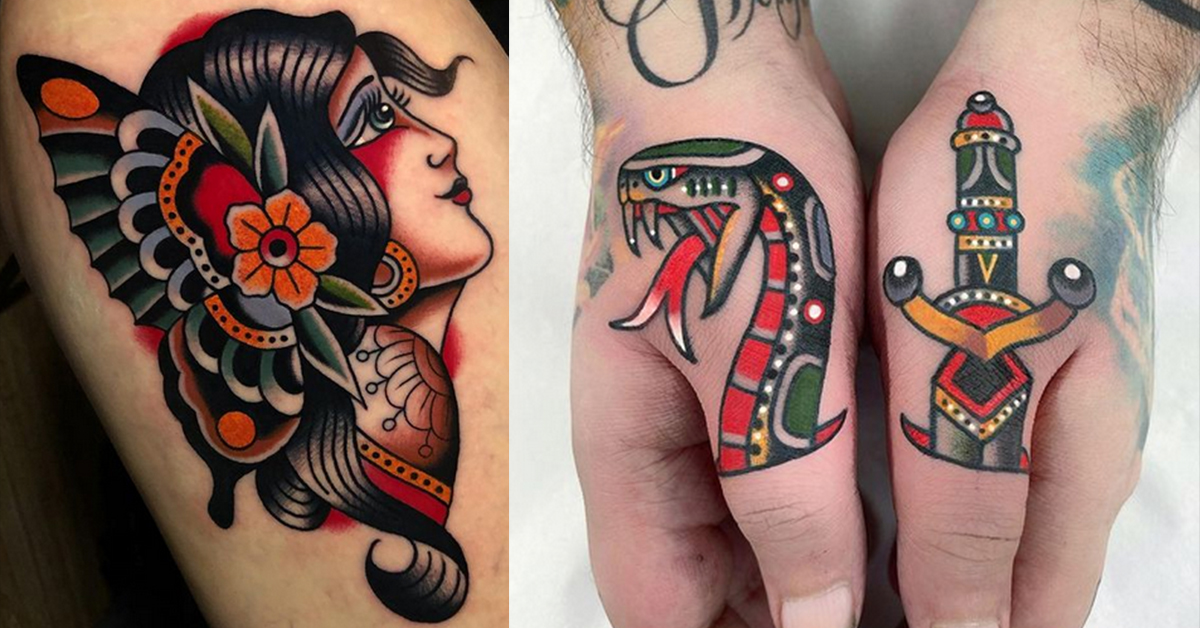
Traditional Tattoo Style
Frequently Asked Questions (FAQ)
1. Does a Traditional tattoo really age better than other styles?
Yes, generally speaking, it does. The entire visual language of the Traditional Tattoo Style tattoo style was designed for longevity. The bold black outlines act as a container, preventing the colours from blurring and spreading over many decades. The simple designs and solid colour packing ensure that the image remains clear and readable even as the skin ages and changes. A well-done Traditional tattoo will still look like a great tattoo in 50 years.
2. Can I get a Traditional tattoo with different, more modern colours or more detail?
Absolutely. When an artist uses the core principles of a Traditional tattoo (bold outlines, simplified design, solid shading) but incorporates a wider, more modern and nuanced colour palette and adds more detail, it is often referred to as “Neo-Traditional.”17 It’s a beautiful evolution of the style. You can absolutely work with one of our artists to create a piece with a traditional feel but with colours that are unique to you.
3. Is this style only for men?
Not at all. This is an outdated stereotype. While it has a traditionally masculine energy, rooted in its military and working-class origins, its timeless appeal and powerful imagery have made it a popular and empowering choice for people of all genders in the modern era. The iconic motifs—roses, swallows, daggers, and hearts—are powerful symbols for everyone.
4. How much does a Traditional tattoo cost in London?
The cost of a tattoo is determined by its size, complexity, and the time it takes to complete, not by its style. A simple Traditional design may be quicker and therefore more affordable than a highly detailed realism piece of the same size. However, a large, complex, and perfectly executed Traditional back piece from a master artist will be a significant investment, just like any other large-scale tattoo.
5. Can you create a custom design for me that uses Traditional motifs?
Yes, this is our specialty. Our artists are experts at taking the classic lexicon of the Traditional Tattoo Style tattoo style and using it to tell your unique story. You can collaborate with an artist to combine different motifs, create a unique composition, and design a piece that has the timeless power of a classic design but is 100% original to you.
Conclusion
The Traditional Tattoo Style tattoo style is more than just an aesthetic; it is a living history, a testament to a craft built on a foundation of rules, respect, and a commitment to creating art that lasts. It is a language of bold lines, powerful colours, and timeless symbols. Its unapologetic confidence and enduring readability make it a choice that will never go out of style. It is a true classic, a piece of art that is as powerful and relevant on the streets of London in 2025 as it was in the port cities of a century ago.