
Where to Get a Septum Piercing in London: Choosing the Right Studio

The septum piercing has achieved an iconic status in the world of body modification. Once a symbol of punk rebellion, it has gracefully evolved into a versatile and sophisticated statement of style, equally at home in a Shoreditch art gallery as it is in a Soho design studio.1 Its unique blend of edginess and elegance allows for a huge range of expression, from a subtle, hidden ring to a bold, ornate clicker.2 It’s no surprise that the search for the perfect septum piercing London has become a key mission for the city’s style-conscious individuals.
But beneath this popularity lies a critical truth: the septum piercing is one of the most frequently botched piercings in the industry. The difference between a perfectly straight, high-and-snug piercing and a painful, crooked one that hangs unflatteringly comes down entirely to the skill, knowledge, and experience of the artist performing it. Choosing the right studio is not just about aesthetics; it is the single most important decision you will make for the health and success of your piercing.
This guide is your definitive resource for navigating that choice. We will break down what a correct septum piercing actually is, what to look for in an artist’s portfolio, what to expect during the procedure, and the red flags you must avoid. This is your expert checklist for anyone asking, “Where can I get a truly professional septum piercing London?”
The Anatomy of a Perfect Septum Piercing: Understanding the “Sweet Spot”
Before you can even begin to assess a piercer’s skill, you need to understand what they are aiming for. This is the foundational knowledge that will empower you to identify a true professional. The secret to a successful, relatively painless, and quick-healing septum piercing lies in a small, specific area of the nose often called the “sweet spot.

septum piercing
What is the “Sweet Spot”? (The Columella)
A correct septum piercing does not go through the thick, hard cartilage that separates your nostrils.3 Piercing this cartilage is excruciatingly painful, takes over a year to heal, and is the mark of an untrained, incompetent practitioner.
Instead, the piercing passes through a thin, soft membrane of tissue located at the tip of your nose, just below the cartilage.4 This area is technically called the columella. Think of it like the soft, fleshy webbing between your thumb and index finger. It’s a small, pliable area with very few nerve endings, which is why a correctly performed septum piercing is surprisingly low on the pain scale for most people.
You can often feel this spot yourself. Gently pinch the tip of your septum between your thumb and forefinger and feel upwards. You will feel the hard, rigid cartilage higher up, and then a softer, more flexible area just below it before you reach the fleshy bottom of your nose. That soft spot is the target. A professional piercer is an expert at locating this area, which is the key to a great septum piercing London.
The Unfortunate Consequences of a Badly Placed Septum Piercing
The internet is filled with horror stories and unflattering photos of poorly done septum piercings. These issues are almost always due to incorrect placement by an inexperienced or unqualified piercer.
- Piercing the Cartilage: This is the most severe error. Not only is the initial pain immense, but the healing process is brutal and prolonged, often lasting well over a year and being prone to stubborn irritation bumps. The piercing will almost certainly heal crooked due to the pressure and rigidity of the surrounding tissue.
- Piercing Too Low: If the piercing is placed too low, towards the bottom of the nose, it will hang unflatteringly. This placement makes it impossible to wear the delicate, snug-fitting “septum clicker” rings that are so popular. The jewellery will be overly prominent and can even get in the way of eating or drinking.
- Piercing Too Far Back: If the piercing is placed too far back, away from the tip of the nose, it can also look aesthetically odd and can interfere with the natural movement of your upper lip.
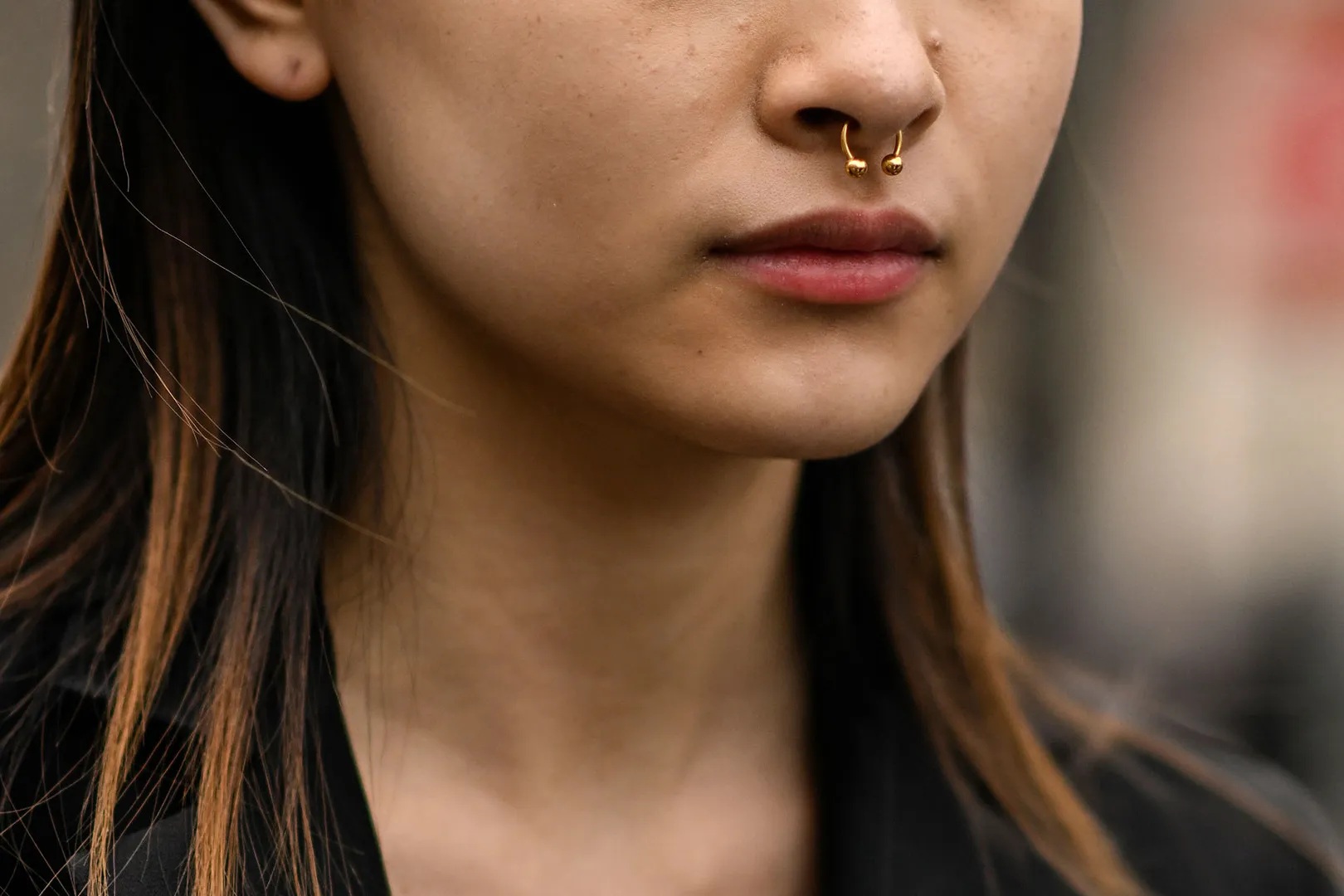
A correctly placed septum piercing is high and snug, sitting neatly at the tip of the nose, allowing jewellery to hang gracefully.
Why Your Unique Anatomy Matters
Not all noses are the same, and a reputable piercer will always start with an anatomical assessment.
- The Deviated Septum: Many people have a deviated septum, where the cartilage wall between the nostrils is not perfectly straight.5 An experienced piercer can almost always still perform a beautiful piercing on someone with a deviated septum. They have the skill to adjust the angle of the piercing channel so that, even if the internal structure is asymmetrical, the jewellery itself hangs perfectly straight. This is an advanced skill that requires a true professional.
- The Elusive Sweet Spot: A very small percentage of people may have a very tiny sweet spot, or one that is almost non-existent. In these rare cases, a reputable piercer will be honest with you. They will explain the risks and may advise that a septum piercing is not a viable option for your anatomy. This honesty is a hallmark of a professional who prioritises your well-being over simply making a sale.

septum piercing
The Hallmarks of a True Specialist: What to Look for in a Portfolio
Once you understand the goal, you can begin your search. In 2025, a piercer’s portfolio is their CV, and Instagram is their gallery. Here’s how to critically analyse their work to find a true septum specialist.
It’s All About the Angles: Analysing Fresh Piercing Photos
When you find a piercing artist in London, their portfolio is your primary tool. Look specifically at their septum work and ask these questions:
- Is it High and Snug? The jewellery should look like it’s neatly tucked into the very tip of the nose, not hanging down from the middle of the septum.
- Is it Perfectly Straight? Look for photos taken straight-on, from the front. The jewellery (especially a circular barbell) should hang perfectly perpendicular to the lips, with both ends at the same height. Even a slight tilt indicates a crooked piercing.
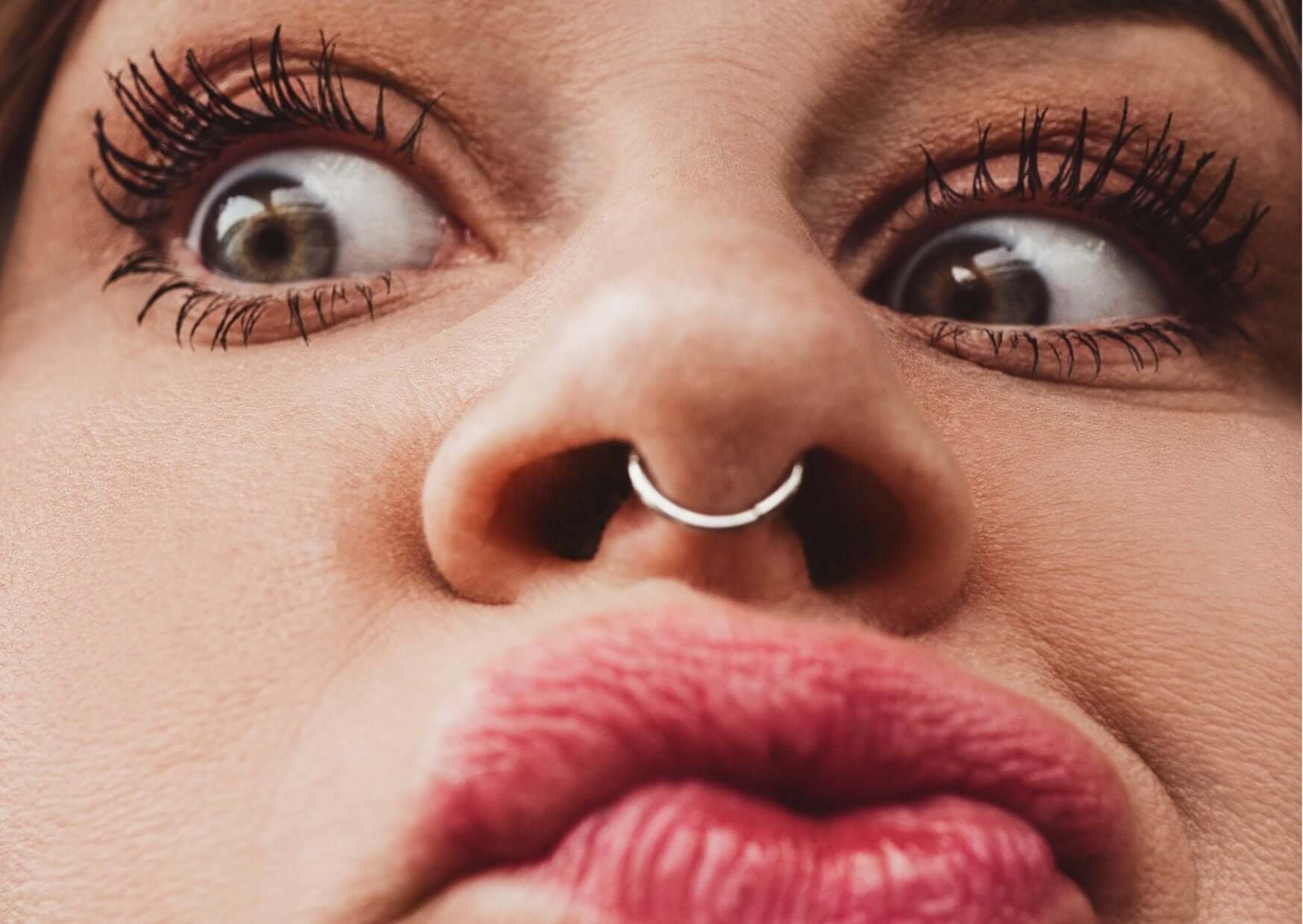
- Is it Symmetrical from Below? This is a pro tip. Look for photos taken from underneath the client’s nose, looking up at the nostrils. This view reveals the entry and exit points of the piercing. They should be perfectly symmetrical—at the same height on each side and the same distance from the tip of the nose. A piercer who posts this shot is confident in their technical precision.
The Real Test: Finding Healed Septum Piercing Photos
This is the most important rule of portfolio analysis. Any piercer can post a photo of a fresh piercing that looks good due to swelling. The true test of their skill is how that piercing heals. A great piercer will be proud to showcase their healed work. Look for photos of septum piercings that are several months or even years old. A perfectly healed piercing will:
- Have clean, healthy-looking entry and exit points.
- Show no signs of irritation, redness, or bumps.
- Have jewellery that is still hanging perfectly straight and snug.
A portfolio filled with beautifully healed work is the ultimate sign of a skilled and trustworthy artist.
The Jewellery Tells a Story
The quality of the jewellery an artist uses is a direct reflection of their professional standards. A specialist’s portfolio will be filled with initial piercings done with high-quality, implant-grade titanium circular barbells or rings from reputable manufacturers. If you see a portfolio filled with low-quality, externally threaded jewellery, or brightly coloured mystery metals, it is a major red flag. An artist who showcases a variety of beautiful, high-end jewellery (even in healed photos) shows that they are connected to the quality-focused side of the industry.
The Procedure: A Step-by-Step Guide to a Professional Septum Piercing
Knowing what to expect can greatly reduce anxiety. A professional procedure is a calm, meticulous, and transparent process.
- The Consultation and Jewellery Selection: Your appointment will begin with a conversation. The piercer will assess your anatomy, ask about your lifestyle (e.g., if you need to hide the piercing for work), and discuss your long-term goals for the piercing (as this can influence placement).6 You will then select your initial jewellery from a collection of sterile, implant-grade options.
- The Setup and Marking: You will be taken to a private, clinical-grade procedure room. The piercer will wash their hands, put on disposable gloves, and set up a sterile field. They will then thoroughly disinfect your nose. Using forceps (clamps) to gently hold and isolate the sweet spot, they will use a sterile skin marker to place two small dots, indicating the entry and exit points.
- Client Approval: This is a crucial step. You will be given a mirror and as much time as you need to inspect the marks. The piercer will not proceed until you are 100% happy with the proposed placement. You are in complete control.
- The Piercing Moment: Once you give your approval, you’ll be asked to take a deep breath in and then a long, slow exhale. On the exhale, the piercer will pass the single-use, sterile needle through in one smooth, quick motion. The sensation is often described as a sharp pinch that can make your eyes water involuntarily (a completely normal reflex).7 It is intense, but it is over in a second.
- Jewellery Insertion and Finish: Immediately following the needle, your chosen jewellery is inserted into the new channel, often with the help of a sterile taper pin to ensure a smooth, trauma-free transfer. The jewellery is secured, the area is cleaned one final time, and you’re done.
septum piercing
Healing and Aftercare: Your Guide to a Happy Healed Septum
A septum piercing London is known for having a relatively straightforward healing process compared to many cartilage piercings, if it is pierced correctly through the sweet spot.
The Healing Timeline: Initial vs. Fully Mature
- Initial Healing (4-8 weeks): This is the period where the piercing is essentially an open wound. It will be tender, especially if you accidentally bump it. During this time, you must follow your aftercare routine diligently.
- Full Maturation (6-9 months+): After the initial couple of months, your piercing will likely feel healed. However, the internal channel of tissue (the fistula) is still strengthening and maturing. It’s important to be gentle with it and not change the jewellery too frequently during this time.
The “Septum Funk”: A Normal Part of Healing
Don’t be alarmed if you notice a particular, slightly funky smell coming from your piercing as it heals. This is incredibly common and is simply the result of sebum (natural skin oils) and dead skin cells accumulating in and around the piercing channel. It is not a sign of infection. Regular, gentle cleaning will keep it manageable, and it will eventually go away as the piercing matures.
Flipping Up Your Septum for Work or School
One of the great advantages of a septum piercing is that it can often be hidden. If you need to conceal your piercing, you must be pierced with a circular barbell (a “horseshoe”). The piercing can be flipped up into your nostrils immediately after being pierced, but it must be left in the “up” position for the entire initial healing period (at least 4-8 weeks). Constantly flipping it up and down will cause significant irritation and delay healing.
The Simple Aftercare Routine
- Clean 1-2 times a day with sterile saline solution. You can buy this as a spray (often called “wound wash”) from a chemist or your piercing studio.
- Do not use harsh chemicals. Avoid alcohol, peroxide, TCP, and tea tree oil. These are far too aggressive and will do more harm than good.
- Do not touch, twist, or fiddle with your jewellery.
- Be careful when washing your face or blowing your nose.
Frequently Asked Questions (FAQ)
1. I have a deviated septum. Can I still get a septum piercing?
In most cases, yes. This is where finding a truly experienced artist is critical. A skilled piercer can compensate for a slight deviation by adjusting the angle of the piercing so that the jewellery hangs straight, even if your cartilage is not. This must be assessed in person during a consultation.
2. How bad does a septum piercing hurt, really?
If done correctly through the “sweet spot,” most people rate the pain at a 3-4 out of 10. It is a very quick, sharp pinch that often causes your eyes to water reflexively. It is generally considered to be one of the less painful piercings. If a piercer tells you it is extremely painful, they are likely planning to pierce through your cartilage, and you should leave immediately.
3. Will a septum piercing damage my sense of smell?
No. The piercing is located at the very front of the nose, far away from the olfactory sensors which are located much higher up in the nasal cavity. A correctly performed septum piercing has absolutely no effect on your sense of smell.
4. What is the average price for a high-quality septum piercing in London?
You should be wary of any studio advertising very low prices. For a professional septum piercing London in 2025, you should expect to pay a service fee of around £35-£55, plus the cost of the initial implant-grade jewellery (which typically starts around £25-£40 for a basic titanium piece).
5. Can I hide the piercing immediately after getting it done?
Yes, if you are pierced with a circular barbell (horseshoe). You can ask your piercer to flip it up for you immediately after the procedure. It must then be kept flipped up for the entire initial healing phase to avoid irritation.
6. Why does my friend’s septum piercing hang down so low and look crooked?
This is almost certainly the result of poor placement. The piercer likely pierced them too low, missing the sweet spot entirely, or they pierced them at a bad angle. This is the most common mistake made by inexperienced piercers and is the number one reason why it’s so important to do your research.
septum piercing
Conclusion
A septum piercing is a beautiful, versatile, and empowering piece of body art, if it is performed correctly. The difference between a perfect, elegant piercing and a painful, misplaced disaster lies entirely in the skill, knowledge, and integrity of the artist you choose. Your journey to a great piercing does not start when you walk into the studio; it starts with your research.
By taking the time to understand correct anatomy, critically analyse portfolios, and choose a specialist who prioritises your safety, you are guaranteeing a result you will love for a lifetime.