
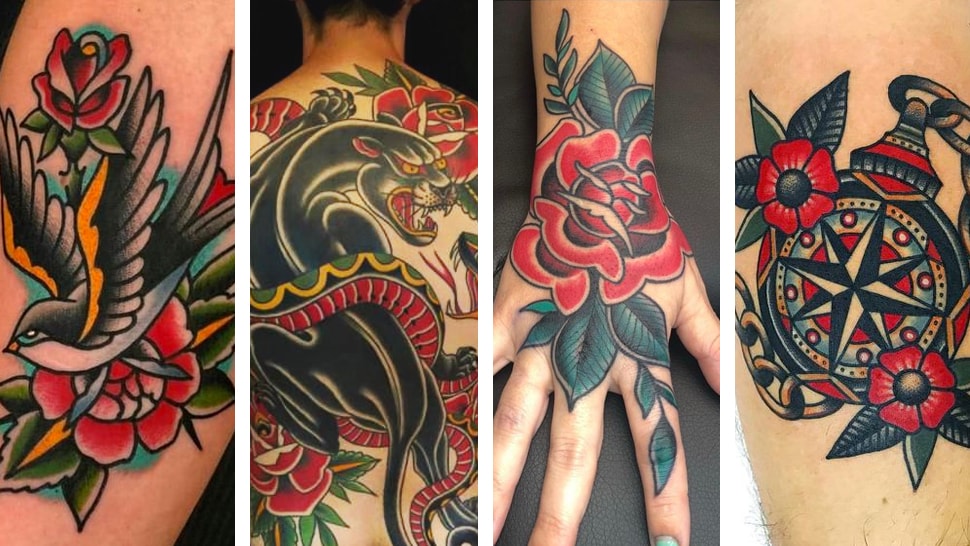
In the rich and storied history of Western tattooing, the American Traditional style stands as a monumental pillar. Its bold lines and powerful simplicity are the bedrock upon which generations of artists have built their craft. But art, in all its forms, is never static. It is a living, breathing entity that evolves, adapts, and reinvents itself. In the late 20th century, a new generation of artists, raised on the foundational rules of the old masters, began to ask a powerful question: What comes next? The answer was a vibrant, dramatic, and breathtakingly artistic evolution. Welcome to the world of the Neo-Traditional Tattoo Style.
This is not a rejection of the past, but a masterful expansion of it. Neo-Traditional takes the unbreakable “Bold Will Hold” philosophy of its predecessor and infuses it with a new level of detail, a richer and more expansive colour palette, and a sophisticated, illustrative quality. It is a style that is at once classic and contemporary, powerful and ornate, familiar and yet thrillingly new. It is the perfect fusion of timeless durability and modern artistic expression, which has made it one of the most popular and respected styles in the world of tattooing today.
At midnightt, our private, appointment-only studio in London is home to specialist artists who are masters of this decorative and dynamic style. This is your definitive guide to the Neo-Traditional Tattoo Style. We will explore its origins, deconstruct its key aesthetic features, showcase its most common motifs, and explain how our artists can create a bespoke, artistic, and dramatic collector’s piece that is unique to you.
Neo-Traditional Tattoo Style
The Birth of a New Tradition: Origins and Influences
To understand the Neo-Traditional style, one must first understand the artistic climate from which it emerged. It was a movement born from a deep respect for the past and an insatiable hunger for the future.
A Reaction and an Evolution (USA and Europe, 1980s–1990s)
The origin of the Neo-Traditional style can be traced to the USA and Europe, during the 1980s and 1990s. During this period, tattooing was experiencing a massive cultural resurgence. A new wave of artists with formal art school training was entering the industry, bringing with them a vast array of new influences and a desire to push the technical and artistic boundaries of the medium. These artists revered the work of the old masters like Sailor Jerry, understanding that the principles of bold outlines and heavy black shading were the secrets to a long-lasting tattoo. However, they felt constrained by the stylistic rigidity and limited palettes of the classic American Traditional style. They wanted to create tattoos with more depth, more dimension, and a more illustrative and personal quality.
This movement was also heavily influenced by other art forms beyond the tattoo world. The flowing, organic lines and decorative flourishes of Art Nouveau, the clean geometry of Art Deco, and the detailed, narrative quality of classic illustration all began to find their way into tattoo designs. The result was a new hybrid style—one that had the strong bones of American Traditional but was adorned with a new, more decorative and artistic skin.
The Core Philosophy: Honouring the Past, Embracing the Future
The fundamental philosophy of the Neo-Traditional Tattoo Style is one of evolution, not revolution. It does not seek to tear down the rules of the past, but to build upon them. An artist working in this style understands that a tattoo must, first and foremost, be a good tattoo—one that will hold its shape and clarity for a lifetime. They therefore retain the core principles of a strong outline and good contrast. However, they then layer upon this foundation a level of detail, colour blending, and compositional complexity that the old masters, with their limited technology and pigments, could only have dreamed of. It is a style that is deeply respectful of its roots while being unapologetically modern in its execution.
Deconstructing the Aesthetic: The Key Features of the Neo-Traditional Tattoo Style
The visual language of the Neo-Traditional Tattoo Style is rich, vibrant, and immediately recognisable. It is defined by a specific set of style features that clearly distinguish it from its American Traditional ancestor.
The Evolved Outline: A Foundation of Varied Line Weights
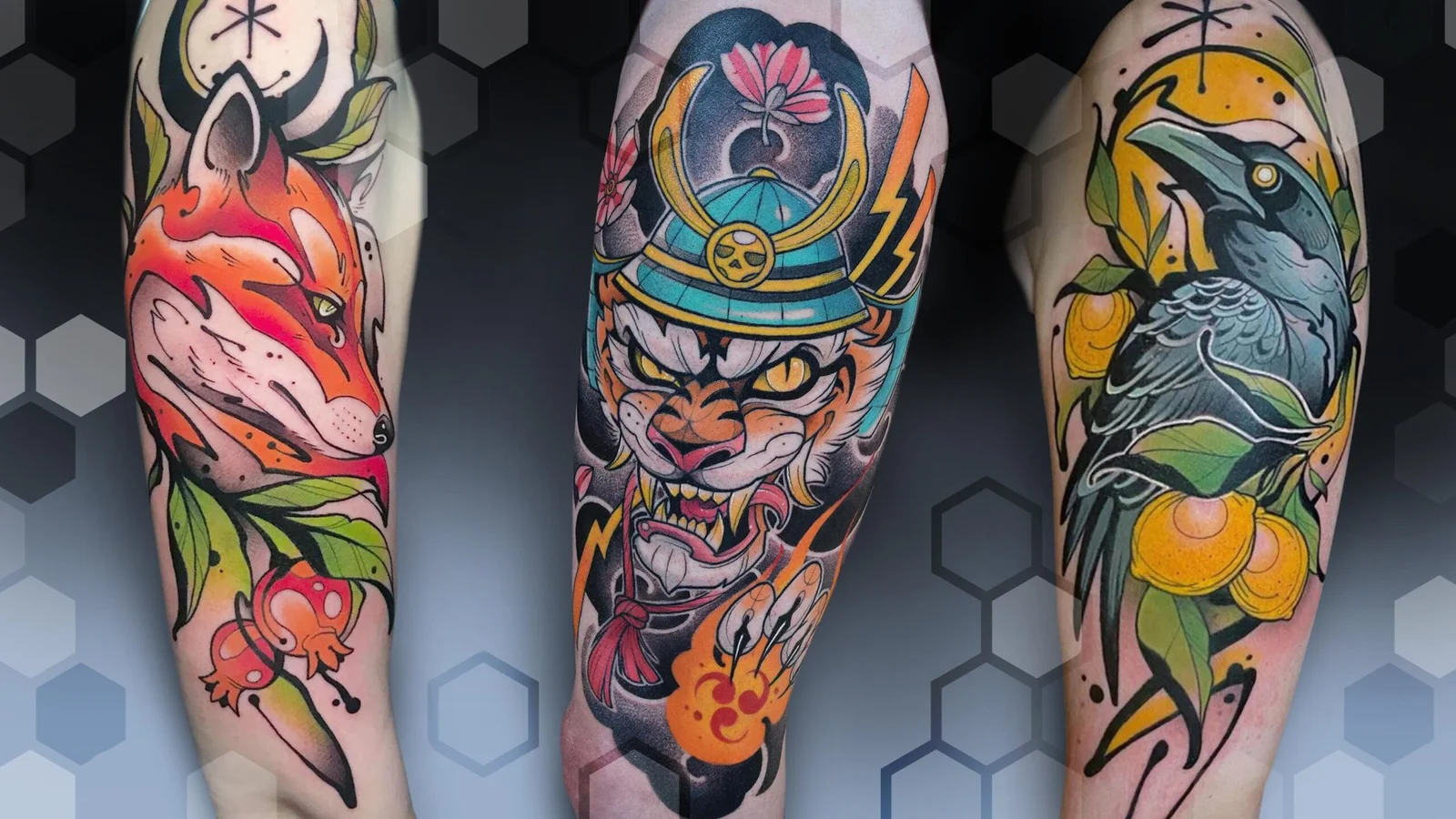
While American Traditional is defined by its single, uniform, heavy black outline, Neo-Traditional introduces a more sophisticated and dynamic approach to line work. Artists in this style use a variety of line weights within a single piece. A thick, bold line might be used to define the main silhouette of the design, ensuring it has that classic, powerful foundation. But within that frame, the artist will use finer, more delicate lines to render intricate details, such as the expression on a face, the texture of fur or feathers, or the delicate veins on a flower petal. This use of varied line weight creates a sense of depth, hierarchy, and visual interest that is a hallmark of the style.
Neo-Traditional Tattoo Style
A Richer, More Expansive Palette: The Beauty of Full Colour
Perhaps the most noticeable feature of the Neo-Traditional Tattoo Style is its use of richer colors. While Traditional was bound to a simple palette of primary colours, the modern Neo-Traditional artist has a virtually limitless spectrum of pigments at their disposal. They are masters of colour theory, using a sophisticated and expansive palette to create a painterly, dimensional look.11 This includes:
- Nuanced Hues: You will see a full range of tones and shades—maroons, ochres, deep purples, teals, and soft pinks—that are absent from the classic style.
- Colour Blending: Artists will often use smooth blending and gradients between different colours to create a sense of light and form.
- Intentional Palettes: The colour choices are often more deliberate and thematic, using analogous or complementary colour schemes to create a specific mood or feeling, much like a painter.
The Art of the Blend: Smoother Shading and Dimensionality
The approach to shading is another key point of evolution. The Neo-Traditional Tattoo Style is defined by its smoother shading and soft, buttery blends.13 While the heavy black shading of American Traditional creates a stark, graphic look, Neo-Traditional artists use it to create a more realistic sense of light, shadow, and three-dimensional form. They are experts at creating soft, peppered gradients that give the tattoo a sense of depth and make the subject appear to lift off the skin. This sophisticated approach to shading is a core part of the style’s dramatic and artistic feel.
A New Level of Detail: The Illustrative Approach
Finally, the style embraces more detail. The simplified, almost symbolic designs of Traditional are replaced with a more illustrative and decorative approach.16 The additional detail is used to convey emotion, texture, and a sense of opulence.17 This is particularly evident in the common motifs of the style. The face of a pin-up girl in a Traditional tattoo might have a simple, formulaic expression. In a Neo-Traditional piece, a portrait will have a nuanced, emotive expression, detailed eyes, and individually rendered strands of hair. This illustrative quality is what gives the style its highly decorative and artistic character.
| Feature | American Traditional | Neo-Traditional |
| Outlines | Bold, uniform black outlines. | Varied line weights (thick, medium, and thin). |
| Colour Palette | Limited strong primary colors (red, yellow, green, blue). | Rich, expansive, and nuanced palette with many tones and shades. |
| Shading | Limited, heavy black shading with stark transitions. | Smoother shading with soft, blended gradients in black and colour. |
| Detail | Simplified, minimal detail, focused on readability. | More detail, illustrative quality, and focus on texture. |
| Overall Vibe | Nostalgic, bold, graphic, and masculine. | Artistic, dramatic, decorative, and ornate. |
The Modern Menagerie: Common Motifs in Neo-Traditional Art
While the Neo-Traditional Tattoo Style can be used for any subject matter, certain common motifs have become hallmarks of the genre. These are often classic tattoo ideas, but they are rendered with a new level of artistry and detail.
The Expressive Portrait
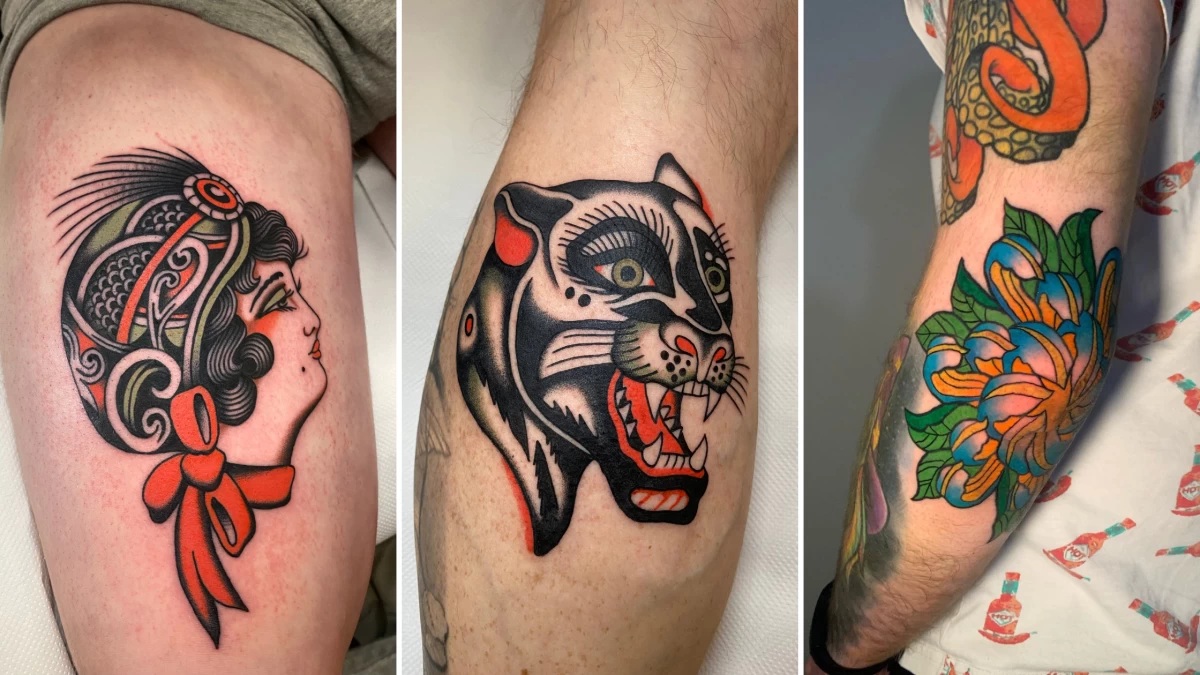
One of the most defining motifs of the style is the stylised portrait, typically of a beautiful, stoic, or mysterious female figure. These are not photorealistic portraits. They are illustrative and highly decorative, often adorned with ornate headdresses, flowing hair, intricate jewellery, and elements from the natural world.The focus is on conveying a specific mood or emotion through the character’s expressive eyes and features.
The Animal Kingdom, Reimagined
Animals are a huge staple of the Neo-Traditional style. The approach allows the artist to capture both the powerful form and the intricate texture of the animal.
- Popular Subjects: Foxes, owls, deer, wolves, and large cats are all incredibly popular.
- The Artistic Approach: An artist might render the soft, fine fur of a fox, the detailed feathers of an owl’s wing, or the intense, glassy stare of a wolf’s eyes. These animal portraits are often framed with decorative elements like flowers, jewels, or ornate filigree.
Neo-Traditional Tattoo Style
The Opulent Flower
Flowers, particularly roses and peonies, are a classic tattoo motif, but in the Neo-Traditional style, they are given a new level of life and dimension. A Traditional rose is a simple, bold symbol. A Neo-Traditional rose is a study in form and light. Each petal is rendered with smooth shading, the leaves have detailed veins, and the colour is a rich, blended gradient of deep reds and soft pinks. They feel lush, vibrant, and opulent.
The Realm of Fantasy
The illustrative and decorative nature of the style makes it the perfect medium for fantasy figures and mythical themes. Dragons, mythical creatures, and characters from folklore are common subjects. The style is also perfectly suited to rendering inanimate objects with a sense of magic and importance, such as ornate lanterns, decorative daggers, antique keys, and precious jewels.
The Vibe & Placement: Creating a Dramatic Composition
The combination of these elements creates a very specific and powerful overall vibe that is perfectly suited to making a significant, standalone statement on the body.
The Feeling of Neo-Traditional: Artistic, Dramatic, Decorative
The Neo-Traditional Tattoo Style is unapologetically artistic. It celebrates the skill of the artist and the beauty of a well-composed illustration. It is dramatic, using rich colours, deep contrast, and emotive subject matter to create a powerful impact. And it is highly decorative, often incorporating ornate, filigree-like details and a sense of opulence that is designed to beautify and adorn the body.
The Ideal Canvases: Best Placements for Neo-Traditional Tattoos
The rich detail and compositional complexity of Neo-Traditional pieces mean they require a good amount of space to be truly appreciated. The best placement options are the larger, broader canvases of the body that allow the design to breathe and flow.
- The Upper Arm, Thigh, and Back: These are the ideal locations. The upper arm (either the outer bicep or shoulder) provides a fantastic, rounded canvas for a portrait or an animal head. The thigh offers a large, flat plane that is perfect for a full, vertical composition, such as a full figure or a large floral piece. The back is the ultimate canvas for a truly epic, dramatic, and large-scale Neo-Traditional masterwork. These placements allow the artist to create a full, impactful composition with a clear focal point and beautiful supporting elements.
Frequently Asked Questions (FAQ)
1. Is a Neo-Traditional tattoo as long-lasting as an American Traditional one?
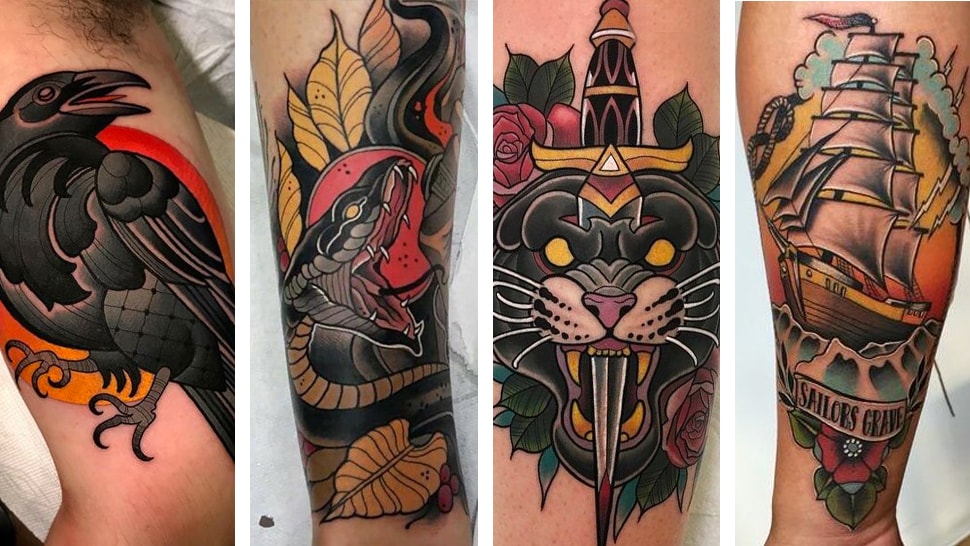
Yes. A well-executed Neo-Traditional tattoo is built on the same foundational “Bold Will Hold” principles as its ancestor. It still uses a strong black outline as its primary structure, which provides the longevity.30 While it incorporates finer lines for detail, a master artist will ensure the core of the design is solid and built to last. It is a style that is designed to look beautiful for a lifetime.
2. Can a design be both Traditional and Neo-Traditional at the same time?
There is definitely a spectrum between the two styles. Some artists work in a style that is very close to classic Traditional, but with a slightly more expanded colour palette.31 Others work in a highly detailed and ornate style that is almost closer to realism. You can absolutely work with an artist to find a balance that suits you, for example, a piece with the simplicity of Traditional but with the smoother shading of Neo-Traditional.
3. What is the main difference between Neo-Traditional and Realism?
While both styles use smooth shading and can be highly detailed, the key difference is the outline. Realism aims to look like a photograph and typically has no bold outlines at all. The Neo-Traditional Tattoo Style always has a clear, visible outline, even if its weight varies.32 It is fundamentally an illustrative style, not a photorealistic one.
4. How much does a Neo-Traditional tattoo cost in London?
The cost of a tattoo is determined by its size, complexity, and the time it takes to complete, not by its style. A complex, highly detailed, and colourful Neo-Traditional piece will be a significant investment, often charged at an artist’s day rate. At a premier London studio like midnightt, a full day session for a large Neo-Traditional piece could range from £800 to £1,500+.
5. Is Neo-Traditional a good style for a cover-up tattoo?
It is an excellent choice for a cover-up. The use of bold outlines, rich and often dark colour saturation, and a high level of detail and texture makes it one of the most effective styles for completely concealing an old, unwanted tattoo. The complex compositions are perfect for camouflaging and distracting the eye from the old design.
Neo-Traditional Tattoo Style
Conclusion
The Neo-Traditional Tattoo Style is the perfect fusion of the old and the new. It is a style that carries the power, strength, and longevity of its classic American heritage, but is infused with the boundless creativity, technical sophistication, and artistic freedom of the modern era. It is a celebration of the tattoo as a true art form—dramatic, decorative, and deeply personal. It is a choice for the individual who respects the past but is not bound by it, and who wants a piece of art that is both timeless in its foundation and contemporary in its execution.