
In the vast universe of tattoo art, some styles are defined by pure aesthetics, while others are born from the very soul of a community. The Chicano Tattoo Style is a powerful and profound example of the latter. It is more than just a look; it is a living history, a visual language of resilience, faith, and identity, etched onto skin. This is an art form that is deeply and unapologetically cultural, emotional, and spiritual, a testament to the Mexican-American experience from which it grew. With its signature black and grey shading with smooth gradients, it has evolved from a clandestine practice into one of the most respected and influential tattoo genres in the world.
This is not a style to be chosen lightly. To wear a piece of Chicano art is to carry a piece of its history, a history of struggle, pride, and an unbreakable connection to faith and family. From the haunting beauty of a Day of the Dead portrait of a woman to the intricate flow of custom script lettering, its common motifs are a lexicon of a rich and complex culture.
At PinkTatPier, we are a collective of artists who hold a deep reverence for the cultural traditions of tattooing. Our pinktatpier studio services are designed for the discerning collector who seeks not just a beautiful tattoo, but an authentic one. We have dedicated specialists who have spent their careers mastering the delicate techniques and understanding the profound symbolism of the Chicano Tattoo Style. This is your definitive guide to this beautiful and historically significant art form. We will explore its origins, deconstruct its key aesthetic features, and explain how our expert artists in London can work with you to create a powerful and deeply personal masterpiece.
Chicano Tattoo Style
A Legacy of Resilience: The Origins of the Chicano Tattoo Style
To understand the unique and powerful aesthetic of the Chicano Tattoo Style, one must first understand its origin. This is not an art form that was born in traditional tattoo parlours, but one that was forged in the crucible of a specific time and place, a testament to the power of creativity in the face of adversity.
Born on the Streets of Los Angeles, 1970s
The distinct visual language we now know as the Chicano style was born in the barrios of Los Angeles in the 1970s. This was a pivotal time for the Mexican-American community. The Chicano Movement, a powerful civil rights movement, was in full swing, fostering a new sense of cultural pride and identity. This style grew out of the “pachuco” subculture and, most significantly, from the clandestine art created within the California prison system.
- The “Jailhouse” Technique and “Paño” Art: In an environment where access to professional tattoo equipment was non-existent, incarcerated Chicano artists were forced to innovate. They ingeniously crafted makeshift, single-needle tattoo machines. With no access to coloured inks, they created their entire palette from a single source: black ink, often derived from soot or pens, which they would dilute with water to create different grey tones. This was the birth of the “single-needle black and grey” technique. This aesthetic was directly influenced by “paño” art—the incredibly detailed ballpoint pen drawings created on handkerchiefs in prison, which were often sent to loved ones. These drawings, with their soft shading and fine lines, became the blueprint for the tattoo style.
A Visual Language of Identity and Faith
The Chicano Tattoo Style became a powerful way for a marginalised community to express its identity, faith, and resilience. The tattoos were a way to carry symbols of home, family, and God in a world that often sought to erase their culture. The motifs were not random; they were a deeply personal and cultural code, a way to declare one’s heritage and one’s story on the most personal canvas of all. What began as a necessity-driven “jailhouse” style soon spread to the streets of LA, where it was refined and perfected by a new generation of artists who opened the first professional Chicano tattoo shops, transforming it from an underground practice into a globally respected fine art style.
Deconstructing the Aesthetic: The Key Features of the Chicano Tattoo Style
The Chicano Tattoo Style is defined by a specific set of visual rules and style features that give it its unique, soft, and realistic yet stylised quality.
Chicano Tattoo Style
The Foundation of the Style: Black and Grey Shading with Smooth Gradients
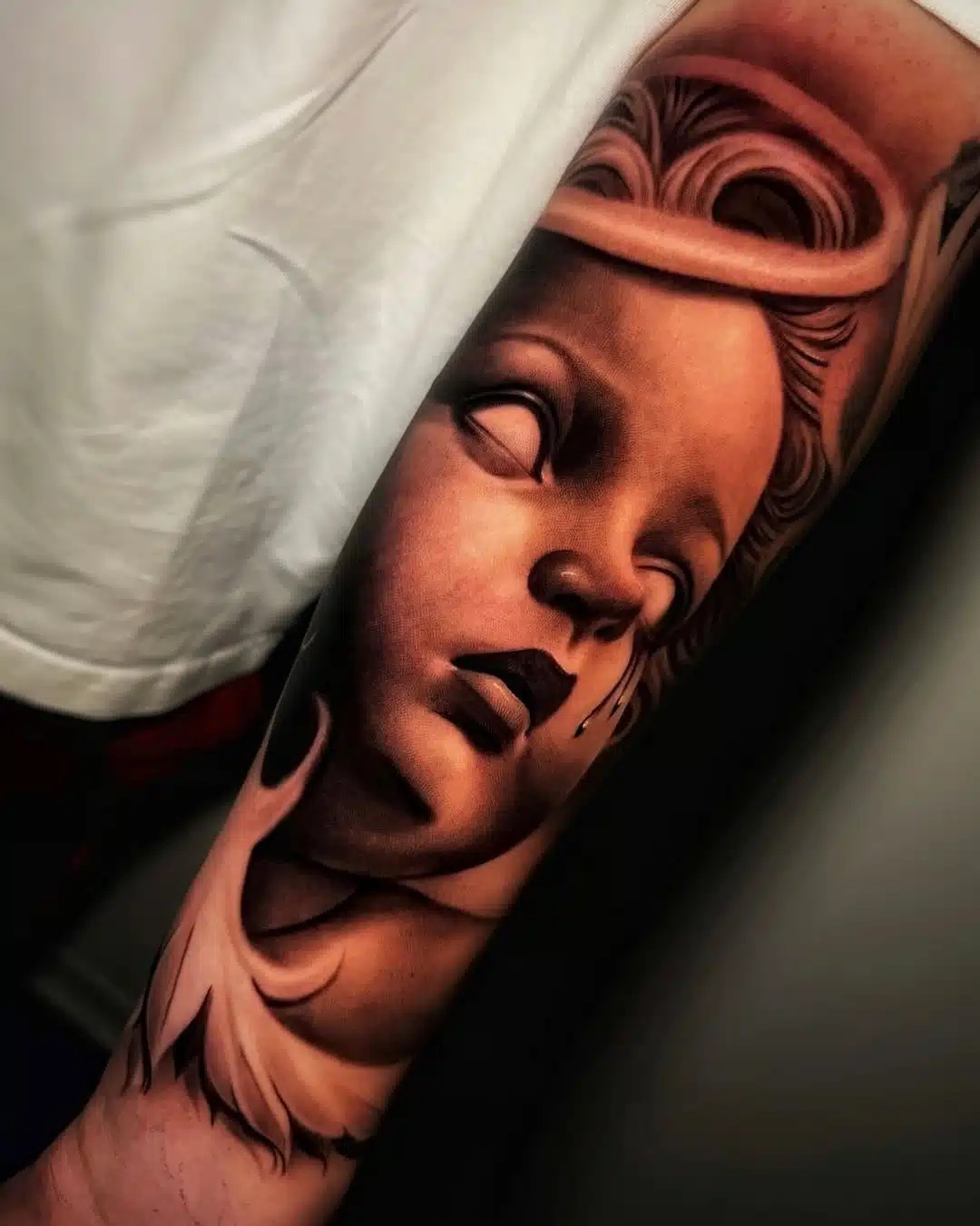
This is the most important and defining feature. The style is almost exclusively created using black and grey shading with smooth gradients.
- The “Grey Wash” Palette: A Chicano artist does not use grey ink. They create their entire tonal range from a single pot of black ink. They create a “grey wash” set by diluting the black ink with distilled water or witch hazel in varying amounts. This gives them a palette ranging from a deep, solid black to a medium grey, a soft, light grey, and every conceivable tone in between.
- The Soft, “Peppery” Shading: The goal is to create incredibly smooth and realistic gradients. Often, this is achieved with a soft, “peppery” shading technique, where the individual dots of ink are visible up close, creating a beautiful, soft texture. This is a direct legacy of the style’s single-needle origins. The ability to create these flawless, buttery-smooth blends is the hallmark of a master of the Chicano Tattoo Style.
The Influence of Fine Line and Intricate Detail
While the shading is soft, the linework is often incredibly fine and precise. This is another legacy of the single-needle “jailhouse” era. Chicano artists are masters of using fine lines to create intricate details, such as the individual strands of hair in a portrait, the delicate petals of a rose, or the elaborate script of a name. This combination of soft, painterly shading and sharp, precise linework is what gives the style its unique and dynamic quality
The Cultural Bedrock: Deeply Rooted in Mexican-American Culture
This is a feature that cannot be overstated. The Chicano Tattoo Style is not just an aesthetic that can be easily copied; it is a visual language that is deeply rooted in Mexican-American culture. To create an authentic piece, an artist must understand the cultural significance of the motifs. The style is a narrative, and the motifs are the vocabulary. An artist who does not understand this vocabulary cannot truly speak the language of the style.
A Pantheon of Symbols: Common Motifs and Their Meanings
The Chicano Tattoo Style has a rich and powerful lexicon of common motifs, each carrying a specific and widely understood meaning within the culture.
| Motif (Symbol) | Common Symbolic Meaning & Interpretation |
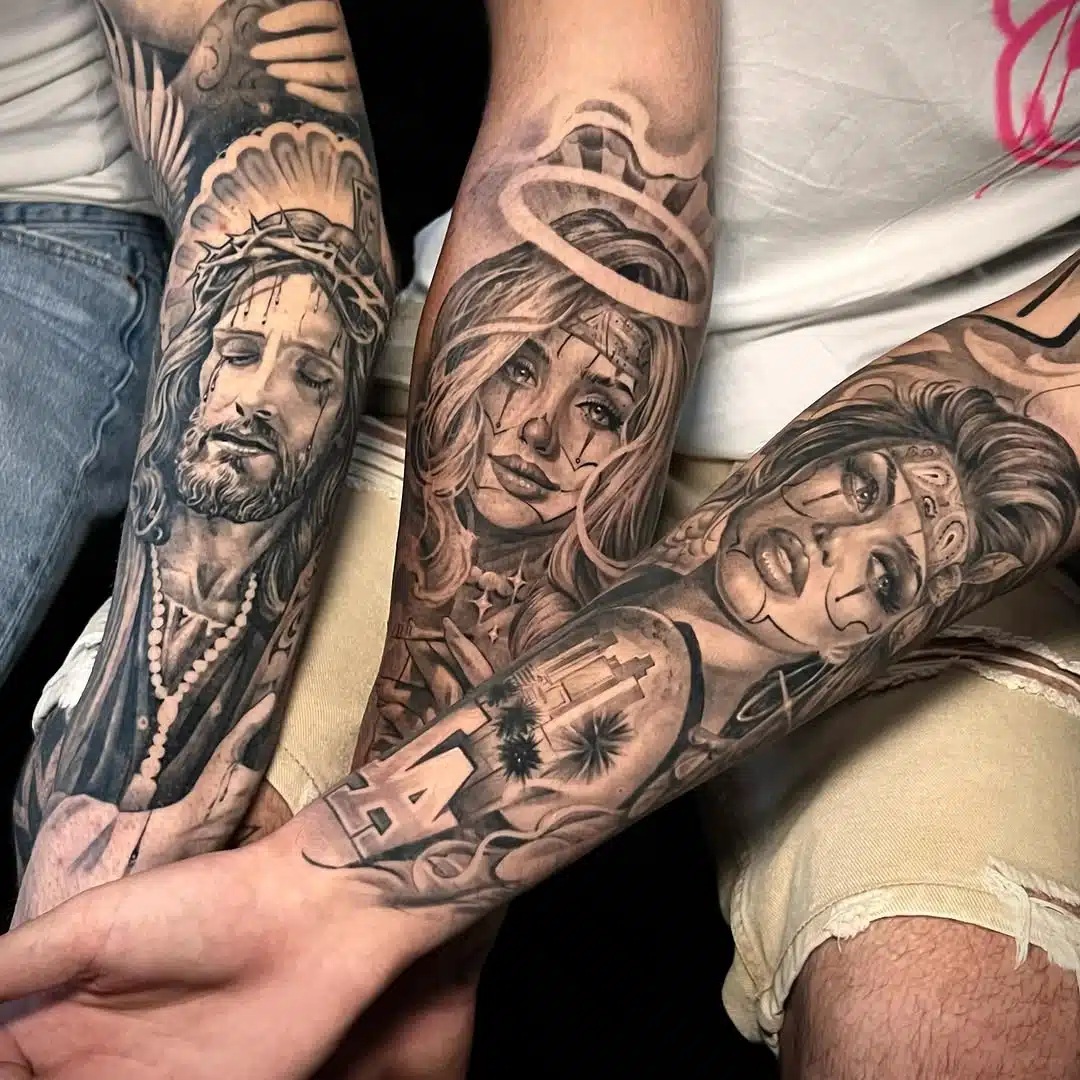
| Portraits of Women | These are often highly stylised, beautiful female faces, sometimes with elements of “Day of the Dead” (Día de los Muertos) sugar skull makeup. They can represent a specific loved one (a mother, a wife, a daughter), an ideal of feminine beauty, or the duality of life and death. They are a core, highly emotional motif. |
| Roses | A classic symbol of love, beauty, passion, and life’s fragility. In Chicano art, the rose is often rendered with incredible softness and realism, a testament to the artist’s skill. A single rose can be a tribute to a loved one. |
| Crosses & Religious Icons | A direct and powerful representation of the Catholic faith, which is a cornerstone of traditional Chicano culture. This includes ornate crosses, praying hands (often from Dürer’s “Praying Hands”), the Virgin Mary (specifically Our Lady of Guadalupe, a hugely important icon), and the Sacred Heart. These motifs are deeply spiritual. |
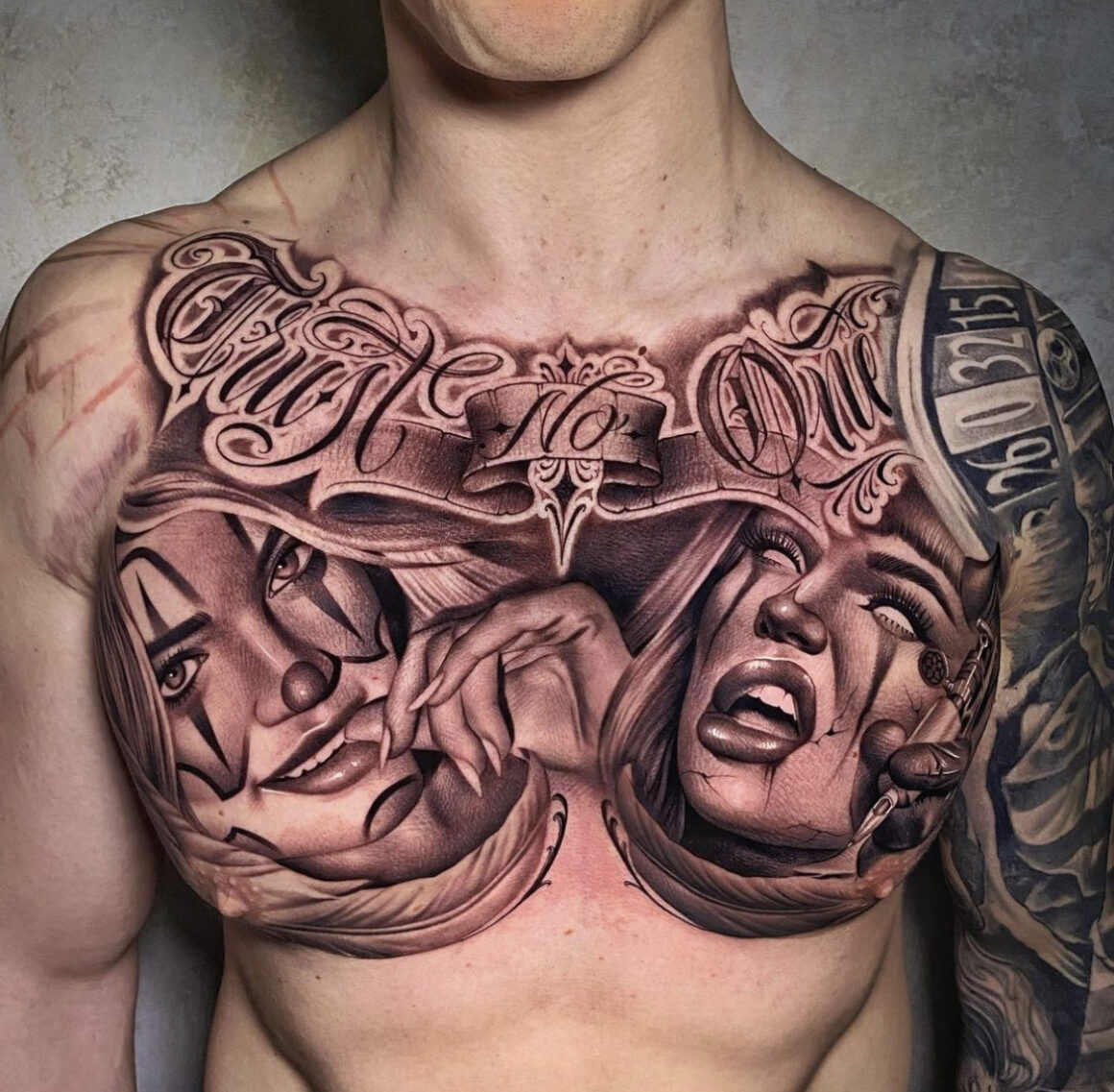
| Script Lettering | Intricate, often calligraphic or “gang script” style lettering, which is an art form in itself. It is used for the names of family members, places (like a neighbourhood or city), or meaningful phrases like “Mi Vida Loca” (“My Crazy Life”) or “Smile Now, Cry Later.” |
| Payasa / “Clown Girls” | A complex and uniquely Chicano symbol. It is typically a portrait of a woman with her face painted with a sad clown’s makeup (often with a single teardrop). It represents the “laugh now, cry later” philosophy, a stoic attitude of putting on a happy face to hide inner pain or struggle. |
The Vibe & Placement: Creating a Spiritual and Emotional MasterpieceThe unique combination of these elements creates a very specific and powerful overall vibe that is deeply personal and culturally resonant.
Chicano Tattoo Style
The Feeling of Chicano Art: Spiritual, Emotional, Cultural
The Chicano Tattoo Style is, above all, cultural. Every element is a direct reflection of the Mexican-American experience. It is profoundly spiritual, with its heavy reliance on Catholic iconography to express faith, hope, and a plea for protection. And it is deeply emotional. The focus on family portraits, memorial pieces, and symbols of struggle and resilience gives the style a raw, narrative power that is unmatched. It is a style that is worn on the heart as much as it is on the skin.
The Ideal Canvases: Best Placements for Chicano Tattoos
The narrative and often large-scale nature of Chicano compositions makes them perfectly suited to the larger canvases of the body.
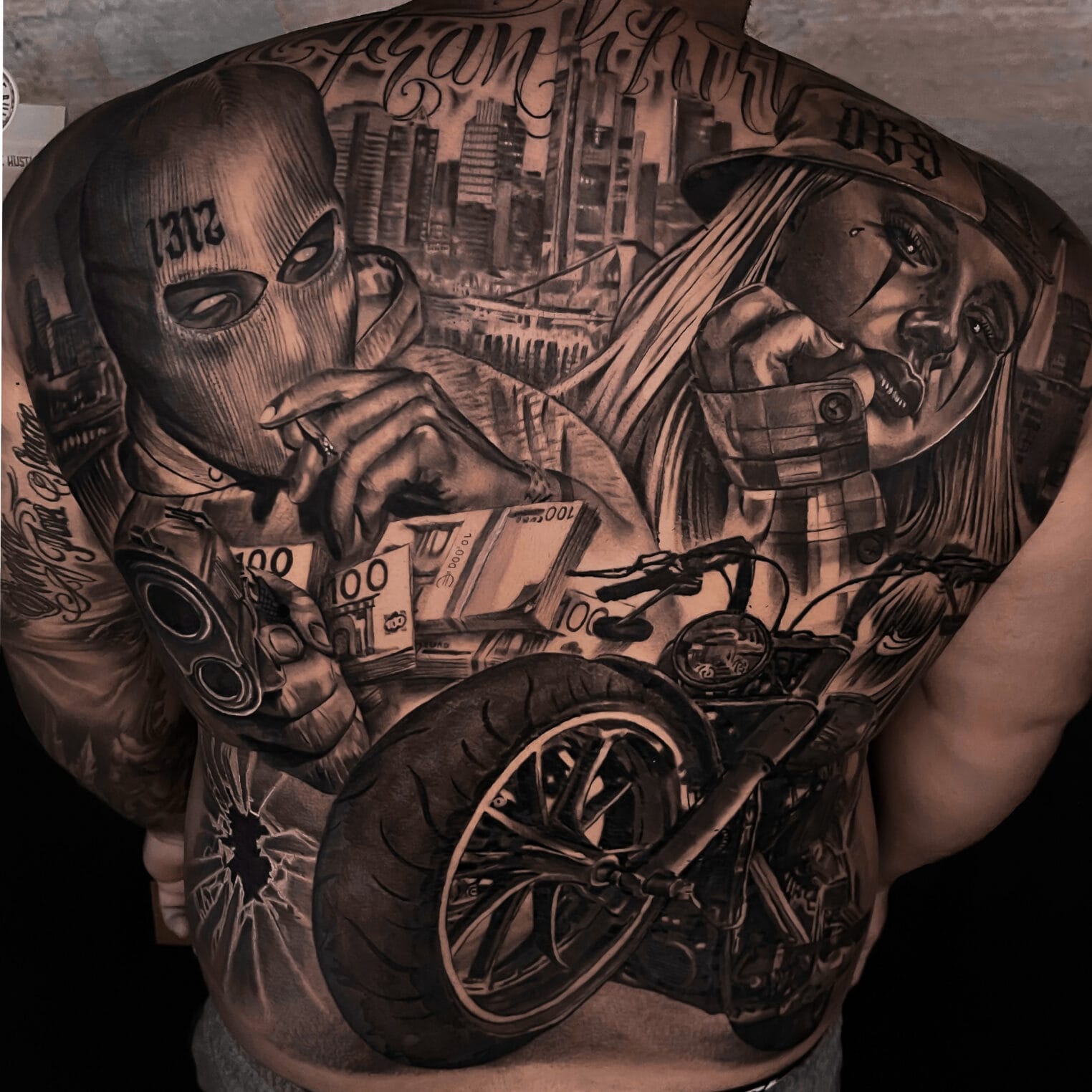
- The Best Placements: The chest, arm, and back are the ideal locations. The chest offers a powerful, symmetrical canvas for a large religious piece or a family tribute. The arm is perfect for creating a seamless, flowing sleeve that can tell a full story, incorporating portraits, script, and symbolic objects. The full back is the ultimate canvas for a truly epic, mural-like Chicano masterwork.
The PinkTatPier Experience: Your Chicano Tattoo Service in London
At PinkTatPier, we hold a deep reverence for the cultural traditions of tattooing. Our pinktatpier studio services are designed for the discerning collector who seeks not just a beautiful tattoo, but an authentic one. We have dedicated specialists who have spent their careers mastering the delicate techniques and understanding the profound symbolism of the Chicano Tattoo Style.
Our Specialist Black & Grey Artists
Creating an authentic Chicano piece requires an artist who is a master of fine-line black and grey, who can create the signature soft, peppery, and smooth shading that defines the style. Our specialists have this technical mastery. More than that, they have a deep respect for the cultural origins of the style. While our studio is in London, our artists are students of this global art form.
The Custom Design Consultation: A Storytelling Session
Your journey begins with an in-depth, collaborative consultation. A Chicano Tattoo Style piece is a personal story. Our process is designed to help you tell it. The artist will work with you to understand your story, your heritage, and the symbols that are most meaningful to you, creating a truly personal and authentic piece of art.
Chicano Tattoo Style
Frequently Asked Questions (FAQ)
1. I’m not of Mexican-American heritage. Is it cultural appropriation for me to get a Chicano-style tattoo?
This is a very important and respectful question. The key is to approach the art form with genuine respect, understanding, and a desire to honour the tradition. While some motifs, particularly those tied to specific gang culture or hyper-personal phrases, may be inappropriate, many of the core themes are universal: faith, family, love, and resilience. Choosing motifs like roses, classic cars, or even the “laugh now, cry later” clowns, when done out of genuine appreciation for the art, is generally seen as acceptable. A consultation with an expert artist is the best way to navigate this respectfully.
2. How well does the Chicano Tattoo Style age?
It ages exceptionally well. As the foundation of modern fine-line black and grey, it is a style that is built for longevity. The use of soft shading means that as the tattoo naturally softens over the decades, the effect is very graceful. A well-done Chicano piece with a strong black foundation will remain beautiful for a lifetime.
3. Is Chicano the same as Black & Grey Realism?
They are very closely related but not identical. The Chicano Tattoo Style is a specific cultural style within the broader category of Black & Grey. It has its own unique set of motifs, its own history, and often a slightly softer, more stylised quality than pure photorealism.
4. How much does a Chicano-style tattoo cost?
The cost of any tattoo is based on the time it takes to complete. Chicano-style tattoos are often highly detailed, custom-drawn pieces that require a high level of skill. You should expect the price to reflect this. A large, complex piece from a specialist artist will be a significant investment, often charged at an hourly or day rate.
5. Is this style good for a cover-up tattoo?
Sometimes. The style’s reliance on soft shading and negative space can make it challenging to cover a very dark or dense old tattoo. However, a skilled artist can often use the complex compositions, rich black areas, and intricate details of a Chicano design to cleverly camouflage an older, faded piece. An in-person consultation is essential.
Chicano Tattoo Style
Conclusion
The Chicano Tattoo Style is so much more than just an aesthetic; it is a living history, a powerful visual language of resilience, faith, and cultural pride. It is a testament to the creativity and spirit of a community that transformed the limitations of their environment into a globally respected art form. It is a choice for the individual who seeks a tattoo with a soul, a piece of art that is as rich in history and emotion as it is in beautiful, soft detail.