
In the diverse and vibrant world of tattoo artistry, some styles command attention through sheer force and boldness, while others captivate with a quiet, mesmerising complexity. The Dotwork / Pointillism Tattoo Style belongs to this second, more profound category. It is an art form of immense patience, precision, and artistic discipline. It is a style where every shadow, every gradient, and every texture is built not from broad strokes, but from the meticulous and deliberate placement of thousands of individual, tiny dots. The result is a tattoo with a unique, ethereal quality, a soft, almost spiritual texture that feels both ancient and utterly modern.
The overall vibe of this style is undeniably calm, meditative, and intricate. It is a choice for the individual who values craftsmanship, spiritual symbolism, and a deeper, more subtle approach to their body art. The process of creating a dotwork tattoo is a slow, rhythmic, and focused journey, a collaboration between an artist with a flawlessly steady hand and a client with a deep appreciation for painstaking detail.
At PinkTatPier, we are home to some of London’s most sought-after specialists in this demanding and beautiful art form. Our pinktatpier studio services are designed to provide a bespoke, master-level experience for clients seeking a sophisticated dotwork piece. This is your definitive guide to the Dotwork / Pointillism Tattoo Style. We will explore its fine art origins, deconstruct its unique technical artistry, and decode the powerful meanings behind its most common motifs, preparing you for a journey into one of the most patient and beautiful tattoo styles in the world.
Dotwork / Pointillism Tattoo Style
A Legacy of Points: The Origins of the Dotwork Tattoo Style
To understand the modern Dotwork / Pointillism Tattoo Style, one must look to two distinct but related sources of inspiration: the revolutionary world of 19th-century French painting and the ancient, ritualistic practices of tribal tattooing.
Inspired by Fine Art Pointillism
The most direct origin and the source of its alternative name, “Pointillism,” is the fine art movement pioneered by French post-impressionist painters like Georges Seurat and Paul Signac in the 1880s.1 These revolutionary artists moved away from blending colours on a palette and instead constructed their entire paintings from thousands of tiny, individual dots of pure colour.
- The Theory of Optical Mixing: Their technique was based on a scientific theory of optics. They believed that when these small dots of different colours were placed next to each other, the viewer’s eye would “mix” the colours together from a distance, creating a more vibrant and luminous image than could be achieved with traditional blending.
- The Translation to Skin: Modern Tattoo artists have adopted this philosophy and applied it to a monochrome palette. Instead of using a standard shading needle to create smooth, blended gradients of grey, a dotwork artist uses a single needle or a small liner to build up those same gradients dot by individual dot. This creates a unique, soft, and almost shimmering texture that is impossible to achieve with any other technique.
Ancient Roots and Modern Tattooing
While its artistic theory comes from 19th-century France, the practical application of dot-based art on skin is an ancient human tradition. Many forms of ancient and tribal tattooing, long before the invention of the electric tattoo machine, were a form of dotwork.
- Hand-Poked Traditions: The traditional tattooing methods of many cultures, such as the Polynesian tatau or the Thai Sak Yant, involved using a tool to manually “poke” or “tap” the ink into the skin, dot by dot.2 This naturally created a stippled, dotted texture.
- The Modern Fusion: The modern Dotwork / Pointillism Tattoo Style is a fusion of these two histories. It combines the sophisticated shading theories of the French Pointillists with the ancient, ritualistic practice of creating an image from dots, all executed with the precision and efficiency of a modern tattoo machine.
Deconstructing the Aesthetic: The Key Features of the Dotwork Tattoo Style
The visual language of the Dotwork / Pointillism Tattoo Style is precise, unique, and instantly recognisable. It is defined by a singular and demanding technical feature.
The Core Technique: Shading and Gradients Created Entirely with Tiny Dots
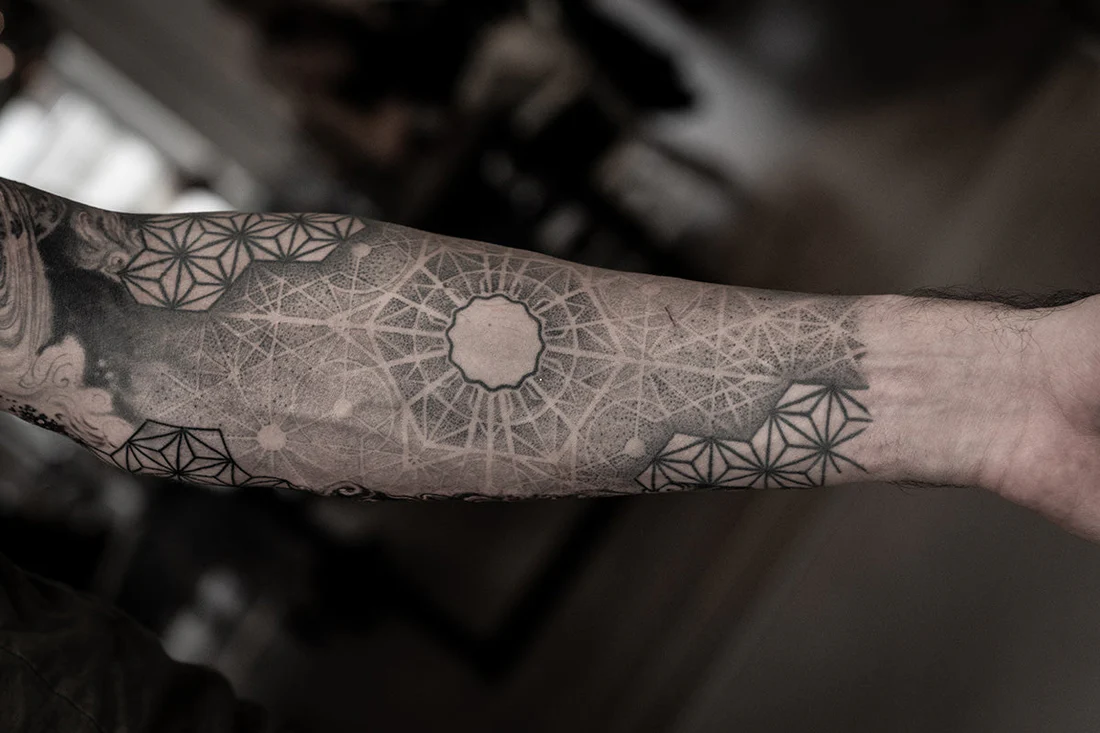
This is the foundational principle that defines the entire style. In a dotwork tattoo, there is no smooth, “whip-shaded” blending created by the sweeping motion of a magnum needle. Every single tone, shadow, gradient, and texture is created entirely with tiny dots.
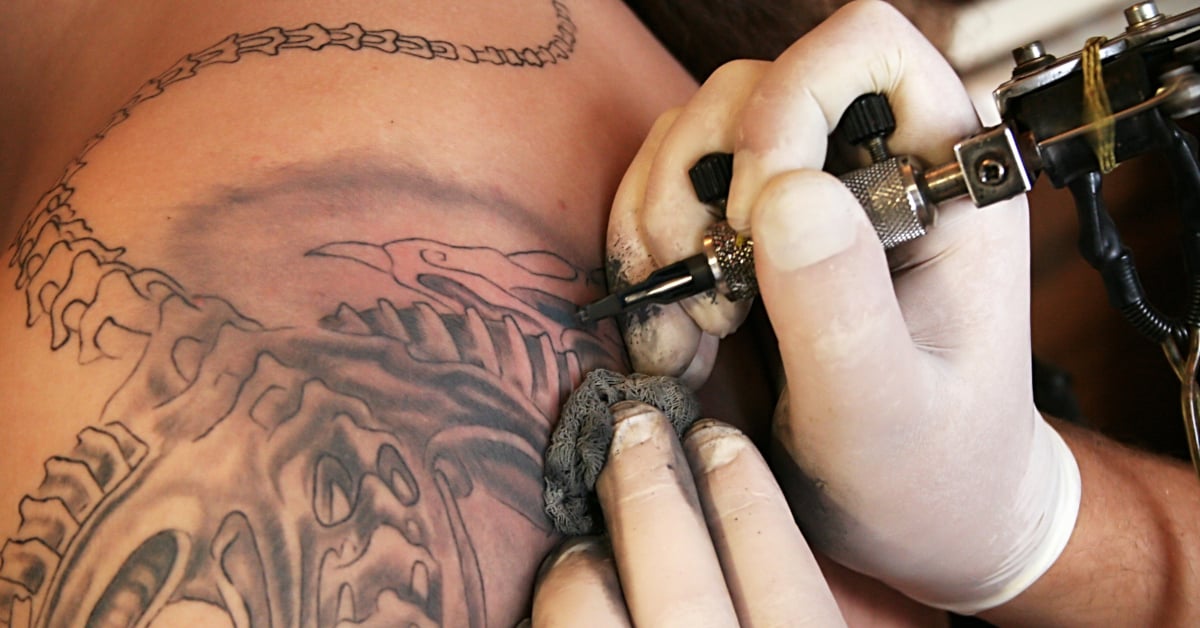
- The Meticulous Process: The artist uses a single needle or a small liner grouping (like a 3RL) and a very fast, precise hand motion to create each individual dot.3 The process is incredibly time-consuming and requires an immense level of focus and consistency from the artist.
- The Art of Density: Creating Tones with Spacing: The magic of dotwork lies in the artist’s masterful control over the density of the dots.
- For Lighter Shades: To create a light grey, airy tone, the artist will place the dots far apart, allowing the negative space of the client’s skin to show through.
- For Darker Shades: To create a mid-tone or a dark grey, the artist will place the dots much closer together, reducing the amount of negative space.
- For Solid Black: To create the illusion of solid black, the artist will pack the dots so tightly together that they completely merge, creating a rich, saturated black with a unique, velvety texture.
- The Unique Texture: The final result of this painstaking process is a tattoo with a texture unlike any other style. It is not smooth and painterly like realism, nor is it stark and graphic like traditional. It has a soft, peppery, stippled, and almost ethereal quality. This unique texture is what gives the Dotwork / Pointillism Tattoo Style its calm and meditative overall vibe.
Dotwork / Pointillism Tattoo Style
A Universe in a Point: Common Motifs in Dotwork Tattoos
While any image can be rendered in the dotwork style, its unique qualities and the meditative nature of the process make it particularly well-suited to certain subjects, especially those with a spiritual or intricate quality.
| Motif (Symbol) | Why it Excels in the Dotwork Tattoo Style |
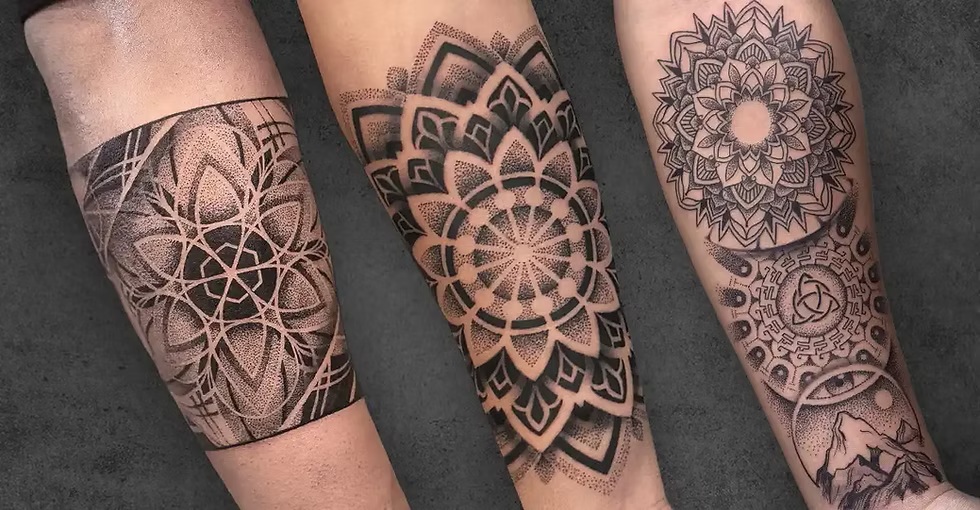
| Mandalas | This is the quintessential dotwork motif. The intricate, repeating geometric patterns of a mandala are perfectly suited to the precise, mathematical nature of dotwork. The soft, stippled shading gives the mandala a sense of depth and a gentle, spiritual energy that is impossible to achieve with other shading techniques. |
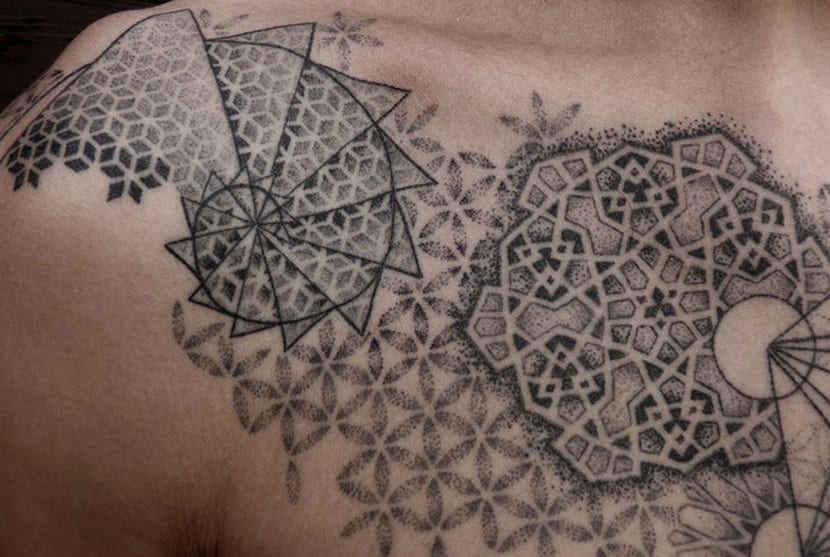
| Sacred Patterns | The dotwork style is the perfect medium for rendering complex sacred geometry patterns like the Flower of Life, Metatron’s Cube, or the Sri Yantra. The precision of the dots allows the artist to capture the mathematical perfection of these symbols, while the soft shading gives them a three-dimensional, energetic feel. |
| Abstract Forms | The ability to create soft, cloud-like gradients makes dotwork ideal for creating beautiful, flowing abstract forms and textures. Artists can create mesmerising patterns that flow with the body, using dot density to create a sense of movement and depth. |
| Nature & Animals | While not as common as in realism, dotwork can be used to render natural subjects with a unique, stylised texture. It is particularly effective for creating the texture of snakeskin, the patterns on an insect’s wing, or the soft fur of an animal. |
The Vibe & Placement: Creating a Calm and Intricate Masterpiece
The unique combination of these elements—the meticulous process and the soft, textured result—creates a very specific and powerful overall vibe that appeals to a client who is looking for a tattoo that is both visually stunning and spiritually resonant.
The Feeling of Dotwork: Calm, Meditative, Intricate
The Dotwork / Pointillism Tattoo Style is, above all, intricate. Its beauty lies in its complexity, in the knowledge that the image is composed of thousands of individual points that come together to create a harmonious whole. The process itself is meditative. The slow, rhythmic, and focused nature of the work creates a calm and almost trance-like atmosphere in the studio for both the artist and the client. This translates into the final piece, which often has a very calm, gentle, and ethereal quality, a world away from the aggressive energy of other styles.
The Ideal Canvases: Best Placements for Dotwork Tattoos
The need for a stable, broad canvas to accommodate the often large, symmetrical, and time-consuming nature of dotwork designs makes certain placements ideal.
- The Best Placements: The arms, chest, and back are the perfect locations for the Dotwork / Pointillism Tattoo Style. The forearm and the upper arm provide a wonderful canvas for a full or half-sleeve of geometric or mandala patterns. The chest offers a powerful, symmetrical canvas for a large central mandala that can extend over the sternum. The large, flat plane of the back is the ultimate canvas for truly epic, large-scale sacred geometry or blackwork pattern pieces that can take many, many hours to complete.
Dotwork / Pointillism Tattoo Style
The PinkTatPier Experience: Your Dotwork Tattoo Service in London
A perfect dotwork tattoo is a testament to the artist’s patience, precision, and unwavering focus. At PinkTatPier, our pinktatpier studio services include dedicated specialists in the art of geometric, blackwork, and dotwork tattooing.
Our Specialist Dotwork Artists
Our studio is a curated collective of artists, each with their own unique voice and area of specialisation. Our dotwork specialists are masters of this demanding technique. They possess the incredibly steady hands, the immense patience, and the artistic eye for composition and gradient required to create flawless, intricate, and beautiful dotwork pieces.
The Custom Design Consultation
Your journey begins with an in-depth, collaborative consultation. A Dotwork / Pointillism Tattoo Style piece must be perfectly fitted to your body’s unique contours. Our artist will work with you to create a completely original design that is not only beautiful but is also perfectly scaled and shaped to flow with your anatomy. This bespoke design process is a hallmark of our professional pinktatpier studio services.
Frequently Asked Questions (FAQ)
1. Does a dotwork tattoo hurt more than a regular tattoo?
The sensation is often described as being different rather than more or less painful. Standard shading can feel like a scraping sensation, while dotwork feels more like a persistent, rapid “pecking” or “stippling” on the skin. Because it is a slower process, the sessions can be long, which can be a test of endurance. However, many clients find the trauma to the skin feels less intense overall.
2. How well does the Dotwork Tattoo Style age?
A well-executed dotwork tattoo ages exceptionally well. Over many decades, the individual dots may soften and merge slightly, but this often enhances the smooth, ethereal quality of the shading. Because the style is built on a foundation of clean lines and a strong understanding of contrast, the overall design remains readable and beautiful for a lifetime.
3. Is dotwork the same as “stick and poke” tattooing?
No. While they can have a similar dotted aesthetic, they are technically very different. “Stick and poke” is a method of tattooing by hand, without a machine.4 The Dotwork / Pointillism Tattoo Style described here is a style of shading that is typically executed with a modern tattoo machine, which allows for much greater speed, consistency, and precision in the dots.
4. How long does a dotwork mandala or geometric sleeve take?
Dotwork is an extremely time-consuming style. The patient, meticulous process of building up gradients dot by dot takes significantly longer than standard shading. A small, simple dotwork piece might take a few hours, but a large, complex mandala or a full geometric sleeve is a massive commitment that can take many, many full-day sessions to complete.
5. How much does a dotwork tattoo cost?
The cost of any tattoo is based on the time it takes to complete. Because dotwork is so time-consuming, a dotwork tattoo will almost always be more expensive than a tattoo of the same size done in a faster style like American Traditional. You are paying for the immense time, focus, and technical skill required from the artist.
Dotwork / Pointillism Tattoo Style
Conclusion
The Dotwork / Pointillism Tattoo Style is a profound and beautiful art form. It is a journey into the beauty of patience, the elegance of precision, and the spiritual power of an image built from a thousand tiny universes. It is a choice for the individual who seeks a tattoo that is both intellectually stimulating and aesthetically breathtaking. Its creation is a testament to the meditative focus and technical mastery of a specialist artist. It is a style that is at once ancient in its roots and unapologetically modern in its clean, crisp execution.