
Office-Appropriate Piercings: A Guide for London Professionals in 2025

The image of the London professional has undergone a quiet revolution. The rigid, dark-suited uniform of the past has softened, giving way to a more nuanced and individualistic approach to personal presentation. In the dynamic, post-pandemic corporate landscape of 2025, personal style is no longer seen as a distraction from professional life, but as an integral part of one’s personal brand. In this new era, where authenticity is valued, body piercings have moved from the realm of weekend rebellion to a sophisticated form of self-expression that can, and does, have a place in the professional world.
But the question remains: how do you navigate this new freedom? How do you express your individual style through body art while still commanding respect, authority, and professionalism in a competitive corporate environment? The answer lies in strategy, subtlety, and an unwavering commitment to quality.
This is your definitive guide to office-appropriate piercings in London. We will move beyond simplistic “yes” or “no” answers and delve into a nuanced exploration of the modern professional landscape. This guide is designed to be a trusted resource for the ambitious London professional who believes that personal style and career success are not mutually exclusive. We will analyse the different corporate cultures across the city, provide a tiered guide to professional placements, and demonstrate how the art of subtlety—through high-quality jewellery—is the key to making your piercings a sophisticated asset to your personal brand, not a liability.

office-appropriate piercings
The London Corporate Spectrum: Understanding Your Workplace Culture
Before choosing a piercing, you must first become an ethnographer of your own workplace. London is not a monolith; its corporate landscape is a diverse ecosystem with vastly different cultures and unspoken rules of presentation. The piercing that is celebrated in a Shoreditch tech start-up may be viewed very differently in a Mayfair law firm. Understanding where your industry and company sit on this spectrum is the first and most critical step.
The “Creative Class” (Hubs: Shoreditch, Farringdon, Soho)
- Industries: Tech, Media, Advertising, Fashion, the Arts.
- The Dress Code: Relaxed, expressive, and trend-aware. Individuality is often encouraged.
- Piercing Acceptance: Extremely high. In these environments, a well-curated and stylish piercing project is often seen as a sign of a creative eye and a connection to contemporary culture. Multiple ear piercings, septum rings, and nostril piercings are commonplace. The focus is not on whether piercings are “appropriate,” but on how artfully and stylishly they are executed.
The “Modern Corporate” (Hubs: London Bridge, Paddington, Victoria)
- Industries: Finance, Major Tech HQs, Consulting, Corporate Management.
- The Dress Code: Smart-casual, polished, and contemporary. The emphasis is on looking put-together and professional, but with more room for personal style than in the past.
- Piercing Acceptance: High, but with a strong emphasis on subtlety and quality. This is the core audience for office-appropriate piercings in London. Multiple lobe piercings, discreet cartilage studs (like a tragus or conch), and even a single, tiny nostril stud are generally accepted, provided the jewellery is high-quality and understated. The key is for the piercing to read as “fine jewellery,” not a “rebellious statement.”
The “Traditional Bastions” (Hubs: The City of London, Canary Wharf, Mayfair)
- Industries: Corporate Law, Investment Banking, Private Equity, Traditional Finance.
- The Dress Code: Formal and highly conservative business attire. The uniform of the suit and tie, or its equivalent, still reigns.
- Piercing Acceptance: This is the most conservative environment. While a single, simple lobe piercing is universally accepted, anything more can still be viewed as unconventional and may go against unwritten codes of conduct. For professionals in these sectors, the strategy revolves around “hidden” piercings—placements that are completely concealed during working hours.

office-appropriate piercings
The “Public Face”: Client-Facing and Executive Roles
It’s important to note that regardless of the industry, your specific role matters. Those in senior management or client-facing positions (such as sales, legal counsel, or consulting) will always be held to a higher standard of presentation. If your job involves building trust with conservative external clients, a more discreet approach to piercings is a wise strategic choice.
A Tiered Guide to Professional Piercing Placements
With an understanding of your workplace culture, you can now consider the piercings themselves. We’ve organised them into tiers based on their general level of acceptance in a “Modern Corporate” environment.
Tier 1: The Universally Accepted – The Lobe Landscape
These are the safest and most widely accepted placements, forming the foundation of any professional piercing project.
- Single Lobe Piercings: The timeless classic. A pair of simple, high-quality studs or small sleepers are appropriate in every professional setting imaginable.
- Multiple Lobe Piercings (Seconds/Thirds): In 2025, having second or third lobe piercings is now considered entirely standard and professional, provided they are styled with small, elegant, and matching studs.
- The Stacked Lobe: This modern trend, involving a small cluster of delicate piercings on the lobe, is a fantastic way to add detail and personality. When styled with tiny, minimalist studs, it is still very discreet and reads as a sophisticated, intentional jewellery choice.
Tier 2: The Subtle & Chic – Discreet Cartilage Piercings
This is the heartland of modern office-appropriate piercings in London. These placements are subtle, elegant, and can be styled to be almost unnoticeable, offering a “hidden gem” effect.
- The Tragus: This piercing, located on the small nub of cartilage in front of the ear canal, is perfect for a professional setting. It is small, forward-facing, and ideally suited to a tiny, sparkling stud. It adds a touch of detail without being overt.
- The Conch: The “peekaboo” piercing. Located in the inner cup of the ear, a conch piercing, when styled with a simple stud, is almost hidden from a direct, face-to-face view. It offers a beautiful flash of personality when you turn your head, making it an excellent choice for a discreet yet stylish statement.
- The Daith: Perhaps the most “hidden” piercing of all. The daith is located on the innermost fold of cartilage.1 It is almost entirely concealed within the ear’s anatomy, making it a perfect secret piercing for even the most conservative corporate environments. It can only be seen from a specific side angle.
- The Forward Helix: A single or double forward helix piercing, adorned with tiny 1.5mm or 2mm studs, can look incredibly chic and refined. Because it sits on the forward-facing part of the ear, it is subtle and blends in with the overall look.
Tier 3: The Statement Makers – Navigating Bolder Placements with Care
These piercings are more visible and require more careful consideration of your specific workplace.
- The Helix: A classic cartilage piercing on the outer rim.2 A single helix stud is often perfectly acceptable. However, a collection of multiple helix hoops might be perceived as less professional in more conservative settings. The choice of jewellery is key here.
- The Nostril Stud: This is the most common facial piercing to have crossed over into the corporate world. In “Creative Class” and many “Modern Corporate” environments, a single, tiny nostril stud (a 1.5mm gem or a simple polished disc) is increasingly common and accepted. However, a hoop or a larger gem is still often seen as a step too far for many offices.
- The Septum Piercing: The acceptance of the septum piercing is growing but is still largely confined to the “Creative Class.” For professionals in more corporate roles, the septum’s greatest advantage is its ability to be completely hidden. When pierced correctly and fitted with a circular barbell (“horseshoe”) or a retainer, it can be flipped up into the nostrils, becoming totally invisible during work hours. This makes it the ultimate “business in the front, party in the back” piercing.
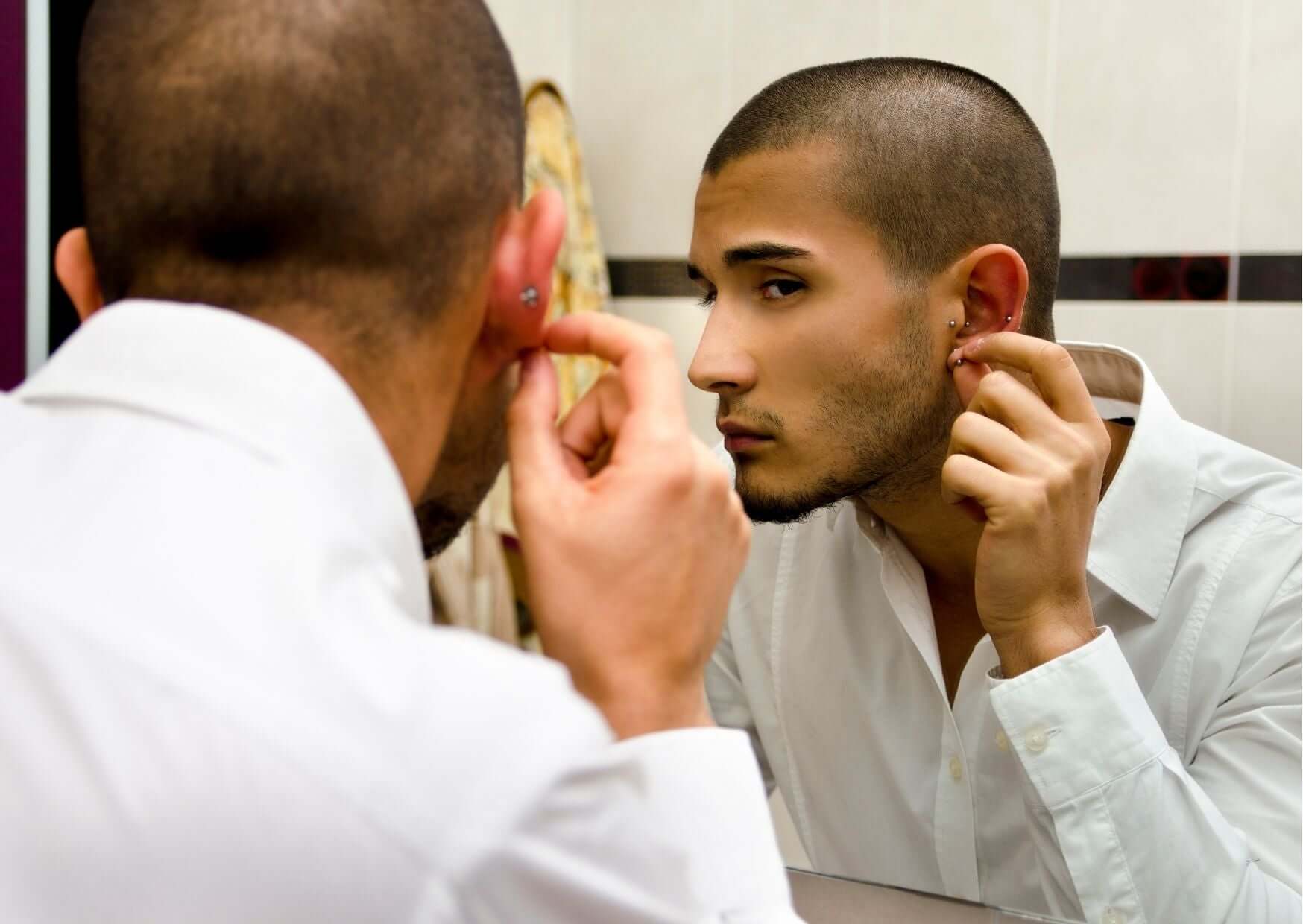
office-appropriate piercings
Tier 4: The “Off-Limits” for Most Corporate Environments
While we believe all piercings are valid forms of self-expression, it is pragmatic to acknowledge that certain placements are generally not considered office-appropriate in most professional London sectors outside of highly creative or alternative industries. These include eyebrow, bridge, medusa, labret, and other lip piercings.
The Art of Subtlety: Jewellery as Your Professional Armour
For office-appropriate piercings in London, the jewellery is not just an accessory; it is the message. The right jewellery can make almost any piercing look sophisticated and intentional.
Material is the Message: Solid Gold and Implant-Grade Titanium
In a professional setting, the material of your jewellery signals everything.
- High-Quality Metals: High-polish, implant-grade titanium (which has a beautiful, soft silver shine) or solid 14k/18k gold (yellow, white, or rose) reads as “intentional fine jewellery.”3 It is understated, elegant, and demonstrates an investment in quality.
- Low-Quality Metals: Dark, peeling, or mystery metals (often found in cheap, externally threaded jewellery) read as “angsty teenager” or “unprofessional.” They can also cause skin irritation and allergic reactions, which is itself an unprofessional look.4
Size and Style Matter: The “Less is More” Philosophy
When it comes to the workplace, discretion is key.
- Studs over Hoops: For most healing and healed cartilage piercings, a small, elegant stud is a more professional and understated choice than a hoop. Hoops can be seen as more casual.
- Tiny is Mighty: Embrace the trend of tiny, delicate jewellery. A 1.5mm to 2.5mm end is all you need. A tiny diamond or a simple gold ball is discreet yet sophisticated, adding a hint of sparkle without drawing undue attention.
- Simplicity is King: Avoid overtly aggressive or thematic jewellery. In a corporate setting, it is best to leave the spikes, skulls, daggers, and overly ornate pieces for the weekend.
The Rise of the “Permanent” Jewellery Concept
A useful way to frame your professional piercings is to think of them as a form of “permanent” fine jewellery. A beautiful, solid gold ring in a healed daith is like a permanent Cartier bracelet; it’s a subtle, elegant piece of luxury that is part of your curated personal brand. When you and your employer see your piercings in this light, they become a seamless part of a polished and professional image.
Frequently Asked Questions (FAQ)
1. I work in a very strict law firm in the City of London. What piercings can I realistically get?
For the most conservative environments, your best options are “hidden” piercings. A daith or a conch (styled with a simple stud) are excellent choices as they are not immediately visible. A septum piercing, fitted with a retainer that keeps it flipped up, is also a perfect option, as it is completely invisible during work hours.5
2. Can I use clear retainers to hide my piercings at work while they are healing?
While retainers can be useful for healed piercings, they are not ideal for a fresh, healing piercing. They are often made of plastic that is not as smooth as implant-grade titanium, and they can be more difficult to clean. It is far better to get pierced in a location that is naturally discreet than to rely on hiding a visible one during the sensitive healing phase.
3. My boss has asked me to remove my nostril piercing. What are my rights in the UK?
UK employment law generally allows employers to set and enforce dress codes, as long as they are not discriminatory based on protected characteristics like religion or race. If the company has a clear, consistently enforced appearance policy that prohibits facial piercings, they are usually within their rights to ask you to remove it. It’s always best to check the company’s official dress code policy before getting a visible piercing.
4. How do I talk about my piercings in a job interview?
The best strategy is to make it a non-issue. For the interview, style your piercings as discreetly as possible. Choose your smallest, most understated, highest-quality jewellery. If you have a septum, flip it up. The goal is for the interviewer to focus on your skills, experience, and professionalism, not your adornments.
5. Is a daith piercing really completely hidden?
For the vast majority of people, yes. Because it is tucked inside the innermost fold of the ear, it is not visible when looking at someone face-on or from the back. It can only really be seen from a direct side profile, making it one of the most discreet and office-friendly cartilage piercings available.

office-appropriate piercings
Conclusion
In the modern professional landscape of London, the conversation around piercings has matured. The question is no longer if you can express your individuality, but how you can do so with sophistication, intelligence, and an awareness of your environment. The key to successful office-appropriate piercings in London is a strategic and thoughtful approach.
It is about choosing discreet placements that complement your anatomy, investing in high-quality, understated jewellery that signals professionalism, and understanding the unique culture of your own workplace. By following these principles, your piercings can become a seamless and elegant part of your professional identity—a quiet celebration of your individuality in the heart of the corporate world.